Showing posts with label Archaeology. Show all posts

Sunday, 12 October 2014

Mosaics from Amphipolis (Kastas Toumba)


Although not yet fully uncovered - and the excavators not having released their thoughts on the find - we believe the image is another "Rape of Persephone". Remember the wall-painting in Tomb A of the Great Tumulus of Vergina, with the same imagery: Hermes running in front of the horses pulling Hades' chariot...

So probably here we have another rendering - in mosaic this time - of the famous lost work of Nikomachus of Thebes.

On a side note: the geometric sceme around the central composition is closely comparable to that of the rape of Helen by Theseus on the mosaic in the house at Pella. It is interesting that this last is dated to 325-300 BC.
The Pella mosaic.
Source:
Proto Thema, 12/10/2014

Sunday, 9 December 2012

Part of the Skeleton of Philip II sent to the Research Centre Dimokritios


To be photographed and investigated.


A small part of the skeletal material of Philip II, that was found in the golden larnax, one of the most precious items of the ancient world, will be transported to the EKEFE Dimokritos and to the

The purpose of this action is to permit the microscopic photographing and investigation of the unknown material that has settled on the bones, which were discovered in the larnax in the main chamber of the tomb II of the Great Tumulus of Vergina.

This material has been observed in other burials in Macedonia, but it is the first time that an exhaustive research is being carried out concerning its mineral and chemical composition, and the results will give us important information concerning the procedure of oxidation of the larnax and concerning the ceremonial materials used at the time.

The demand of the director of the Vergina excavations of the Aristotelian University of Thessalonike, professor Ch. Saatsoglou-Paliadeli, for the transport of the fragments received the light from the Central Archaeological Council.


Source: Αthenian-Macedonian Press Agency

Saturday, 28 April 2012

Greeks, Cypriots and Neolithic Mediterranean Farmers Spread Agriculture to Scandinavia


Source: Kathimerini, 28.04.2012 (Translated from Greek and referenced by A.M.)

Agriculture spread to Europe thousand of years ago from the South to the distant North, with successive steps, according to the Swedish-danish scientific research. The study analysed the DNA of the four [inhabitants of Scandinavia] of the Neolithic period and found that they had many more genes in common with today’s Southern Europeans, as the Greeks, Cypriots the inhabitants of Sardinia, than with any other European people.

The researchers of the Universities of Upsala, Stockholm, and Copenhagen, having at their head Pontus Skoglund and Mattias Jakobsson who published the study in the American journal “Science” according to the French Agency and “Nature”, analysed using new developed techniques, the genetic material that they took from the skeletons of one farmer and three hunter-gatherers, who had been discovered in Sweden and are dated to about 5000 years from the present. The two distinct civilisations, one agricultural and one of hunter-gatherers, coexisted for about 1000 years at a distance of about 400 km, the first in the Swedish hinterland and the second on the island of Gotland, south of Stockholm.

By comparing the DNA of these people of the Stone Age with the DNA of modern populations of Europe, the team found that, from a genetic point of view, the hunter-gatherers were less developed and had a greater relation with the Northern populations – especially the inhabitants of today’s Finland, while the farmer had a very close genetic relationship with today’s Mediterranean populations, especially Cypriots and Greeks.

This discovery by the Scandinavian scientists shows that the ancient farmers transported their agricultural knowledge and technique from the South to the rest of Europe, up to the frozen North, where they finally mingled with the indigenous populations, while teaching them how to grow their food rather than hunt and gather fruits.

As Skoglund stated, the genetic findings reveal that agriculture spread to the whole of Europe by people who live in the Mediterranean and this happened through migratory waves and not just by the cultural transmission of agricultural knowledge from mouth to mouth. “If farming had spread only as a cultural process, we would not find a farmer in the North who has such a genetic relation to the Southern populations”, declared the Swedish scientist.

 The Scandinavian research illuminates a longstanding dispute among scientists concerning the way that farming reached Europe from the Middle East, where it appeared approximately 11000 years ago. At about 3000 B.C. farming had already spread to the greater part of Europe. The basic dispute concerns the way that the transition from the hunter-gatherer lifestyle to that of farmer, and whether farming spread through the migration of farmers or if just ideas and the agricultural know-how spread slowly from civilisation to civilisation. The new study gives more weight to the first view, confirming previous DNA analyses, which had found similar indications about the migration of people themselves from the Mediterranean, who brought their farming knowledge with them.

Furthermore earlier this year scientists published almost all of the genome of “Ötzi”, the Neolotic mummy that was discovered in the Alp in 1991. In this case as well, the genetic analysis shows a very possible Mediterranean origin.

-----------------------------------------------------------------------------------------------------------
Abstract from Science, 27.04.2012: Origins and Genetic Legacy of Neolithic Farmers and Hunter-Gatherers in Europe

The farming way of life originated in the Near East some 11,000 years ago and had reached most of the European continent 5000 years later. However, the impact of the agricultural revolution on demography and patterns of genomic variation in Europe remains unknown. We obtained 249 million base pairs of genomic DNA from ~5000-year-old remains of three hunter-gatherers and one farmer excavated in Scandinavia and find that the farmer is genetically most similar to extant southern Europeans, contrasting sharply to the hunter-gatherers, whose distinct genetic signature is most similar to that of extant northern Europeans. Our results suggest that migration from southern Europe catalyzed the spread of agriculture and that admixture in the wake of this expansion eventually shaped the genomic landscape of modern-day Europe.

Saturday, 8 October 2011

An Important Case of Antiquities Smuggling (Thessalonike, Greece)

by Kostas Onisenko

Ancient objects similar to those that were confiscated by the Department of Illegal Antiquities Trade of the Greek Police last Thursday will be admired by visitors of the large exhibition at the Louvre in Paris "Ancient Macedonia - The Kingdom of Alexander the Great". The antiquities that were located by the police are similar to those that have been discovered in various localities of Central Macedonia, such as Sindos, Archondiko of Pella and elsewhere. "It is certain that these come from an illegal dig, certainly in Central Macedonia" commented a source in the Ministry of Culture. They total 70 objects of great archaeological importance, probably of the 6th century BC. The police handed over to archaeologists four helmets, golden masks, golden mouth-pieces, clay and metal vessels, pieces of an iron sword, various gold pieces and more. The archaeologists have not et determined their exact provenance.

The antiquities were handed over to the Archaeological Museum on the day that they wer e confiscated, in the presence of the Minister of Culture, P. Geroulanos, and the heads of Greek Police.

A source from the Ministry of Citizen Protection speaking to "Kathimerini" spoke of the great interest and the dimensions that this operations took on, and are related not only to the importance of the finding and saving such an important archaeological treasure: 'The geographic provenance of the objects and the fact that they seem to be related to the culture of Alexander the Great's Macedonia is of special importance, as it was imperative that they were not exported. In that case it would have been possible that they be "rediscovered" in an official "excavation" of one of our neighbouring countries. We have indications that such "discoveries of archaeological treasures" had in fact earlier been sold by illegal antiquity merchants from Greece. However this is something extremely difficult to prove", according to the same source.
The Greek Prime Minister Georgos Papandreou and the Minister of Culture Pavlos Geroulanos examine the antiquities.

"People of the Night"

According to information it was about three months ago that the police received the first information pertaining to the case. They contacted the illegal antiquities merchants in the guise of potential buyers and agreed to "buy" the treasure for the sum of 10 mil. euros. During the deal two people were arrested and two more are now wanted. According to police sources the were "people of the night" (mafia).

Source: Kathimerini, 08.10.2011


Supplementary information, taken from the article by
Aggeliki Kopi, Ta Nea.

It appears that the finds come from four or maybe five separate graves. Given that there are four helmets and some objects related to a woman's burial there must be at least five separate graves. It appears that they come from a hitherto unknown burial site.

The objects include: Four helmets, two golden masks with the features of the dead person, gold mouth-pieces, gold plates and jewellery that was attached to the clothes (tainies, circular pieces with the Macedonian star and more), gold rings, pins, and a small silver spoon are amongst the most important of the 70 antiquities recovered. We must also mention a miniature glass amphora with beautiful colours and designs, a phiale bearing the well known ray-decoration (star), an exceptional oinochoe, whose handle ends near the lip in the form of three lion heads, silver vessels, the upper part of a large bronze oinochoe, small clay figurines and a large selection of gold leaf decorated with Macedonian motifs.


According to the report of Aggeliaforos, 25.10.2011 one of those accused in this case disclosed information about the whereabouts of the unknown cemetery: it is said to be located in the larger area of Gerakarou. The archeologists where guided to the spot by the accused, but no announcement has yet officially been made.

Aggeliki Kopi, Ta Nea, 08.10.2011

See also:

Sunday, 25 September 2011

Relations militaires, commerciales et culturelles dans les Balkans de l'époque classique à la période byzantine

Symposium International. Le Livre. La Roumanie. L'Europe.
Section 4C: Relations militaires, commerciales et culturelles dans les Balkans de l'époque classique à la période byzantine. Sinaia, 20-23 September 2011.

The International Symposium entitled "Le Livre. La Roumanie. L'Europe." that took place in the picturesque town of Sinaia has just ended.

It may be surprising that this would be mentioned on this site, if it were not for the Section 4C, which focused on "Military, commercial and cultural relations in the Balkans from the classical to the Byzantine period". Here a number of interesting papers by young and established academics were presented and ideas exchanged.

The full program can be found here:

http://simpozion2011.bibliotecametropolitana.ro/page-detail-fr.aspx?cId=86

accompanied by abstracts. Photos and videos are also available, and the acts will be ready in time for next year's congress!

Monday, 25 July 2011

Revue Archéologique

Revue Archéologique

Nouvelle Série

7 (1866), 13 (Jan.-Jun.) (Galica)
7 (1866), 14 (Jun.-Dec.) (Gallica)
8 (1867), 15 (Jan.-Jun.) (Gallica)
8 (1867), 16 (Jun.-Dec.) (Gallica)

16 (1875), 29 (Jan.-Juin) (I.A.)
16 (1875), 30 (Juil.-Dec.) (I.A.)

Friday, 22 July 2011

A Coin Hoard from Abdera returned to Greece

Return of a Coin Hoard to Greece
Source: Eleutherotypia, 21.07.2011.
By N. Kontrarou-Rassia

A rich American collector bought from a coin auction in New York in 2000 an Archaïc hoard of coins from ancient Abdera.

The hoard bought by 54-year old Jonathan Kagan was made up of 22 silver coins, which he delivered last year in September to the Consulate of Greece in New York, having previously studies them and published his conclusions in a volume dedicated to the great American numismatist John H. Kroll.

His desire was that the hoard enrich the collection of the Numismatic Museum of Athens, in honour of the professor of the University of Texas J. H. Kroll, whose work in a landmark in the study of the coinage of Athens.

How much did the acquisition cost?

The hoard is made up of three didrachms, a drachm, a hemidrachm, two obols and fifteen hemiobols. The coins first appeared in commerce in London in 2000 and were divided. Some appeared in auction catalogues. Greece did not claim them, evidently because it had no evidence of illegal exportation from the country.

Mr Kagan is a director of a company that is active in hi-tech products in New York; he has a degree from Harvard and completed his post-graduate studies in Oxford. He obtained the greater part of the hoard in 2000. He is a collector himself, and in the past has offered pieces from his collection to various American museums. He admires ancient art and his wife is Ute Wartenberg-Kagan, head of the American Numismatic Society, prolific writer on ancient Greek numismatics.


Octadrachm (28,12 gr, 28 mm) of Abdera (c. 500-475 B.C.?). CNG eAuction 256 (25.05.2011), 4. NOT part of the hoard.

How much did the acquisition of the 22 rare coins of Abdera cost? "I do not know. But whether he bought them for a cent or for five millions, what is important is the gesture, which shows that the world is now sensitive and responds to our calls for the return of antiquities", Despoina Evgenidou, director of the Numismatic Museum of Athens told us yesterday. She is already working on the exhibition of the hoard, which will be ready during the second half of November.

The scientific value of the coins is great. They prove that in this early time, the 6th century B.C., people used coins and, what is more, small silver fractions of the drachma, which a few years later were replaced by bronze coins. These coins were not destined to pay taxes or to buy grain from other regions. They were the means to cover everyday needs (food, household objects). "The larger exchanges, as the payment of taxes and long-distance commerce, where largely covered by the silver series, meaning the octadrachms and the tetradrachms", claims the director of the Numismatic Museum. The existence of this treasure shows that moneyed societies existed in very early times. It also tells us what the coinage of Abdera at the end of the 6th century was.

Apollo and Gryffin

"It is a very important donation, because not only does it enrich the numismatic series of Abdera that we have in the Numismatic Museum, but it adds to a very important section of our collections, that of coin hoards", underlines mrs Evgenidou.

Abdera was founded, according to myth, by Hercules, to honour the memory of his comrade Abderus, who had been killed by the mares of Diomedes. The first founder was the Klazomenian Timesios in 654 B.C. The city was refounded in 545 B.C., when migrants from the ionian town of Teos arrived, escaping enslavement by the Persians. The coins of the new inhabitants were similar to those of their old home. On the reverse they bore the head of Apollo and on the obverse a Griffin, the monster of myth that was considered to guard gold and silver mines. This is the type to be found on the coins offered by mr Kagan. The most important ones are those almost invisible to the eye: the small silver fractions that circulated for a few years before being replaced by larger bronze coins.

..................................................................................................

A.M. Notes
:

1. The image that illustrates the original article (not reproduced here) has nothing to do with the hoard under discussion. It is an image from the Hoard Northern Syria, Manbij (?), 2010 (see here), comprised of tertradrachms and drachms of Philip II and Alexander III.
2. The complete title of the publication mentioned is: Jonathan H. Kagan, "Small Coinage and the Beginning of Coinage at Abdera", Agoranomia: Studies in Money and Exchange presented to John H. Kroll, New York 2006, 49-59.
3. The complete composition, as presented by Kagan: 5 Didrachms, 2 Drachms, 2 Hemidrachms (first known), 2 Obols, 18 Hemiobols. Total 29.
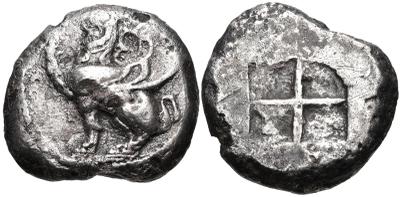
4. The early coins of Abdera did not have the Apollo type. They bore the Griffin on the obverse and an incuse square on the reverse (see photo, above). These are the types that the coins from this hoard bore.
5. For the coinage of Abdera see: J.M.F. May, The Coinage of Abdera, London 1966.

.......................................
On the same subject:

Double axe found in Bugaria

A double axe of the ancient Thracians was discovered in Bulgaria.

It is 22 cm long and was found near the hill called Kozi Gramadi.

From: To Vima, 15.07.2001.

A ceremonial double axe, dated to c. 600 B.C. was brought to light by archaeologists in Bulgaria during excavations carried out in the palace of the rulers of the Kingdom of the Odryses, who were the strongest tribe of ancient Thrace. The iron axe, 22 cm long was discovered near the main gate of the fortified living place of the kings - today's hill of Kozi Gramandi - and, although it is the second that comes to light in an archaeological site of the region, it is considered an especially important discovery, as archaeologists are still trying to understand its exact use.

The double axe found in the digs of Kozi Gramadi.

"The Lavrys, as it was called by the Greeks, was used more for certain ceremonies and less for military purposes or as a household item", explains the head of the dig Ivan Kristoff. Another hypothesis, based on representations in tombs of ancient Macedonia and of the tomb discovered in the Haskovo region, is that the double axe was used in the royal hunt.


Didrachme of Pixodaros (340-334 B.C.), Carian Satrap, bearing the head of Apollo on the obverse and Zeus Labrandos standing r. on the reverse. Künker 136 (10.03.2008), 653.

"If not by the ruler himself, maybe by his comrades", says the archaeologists. "In this sense, the discovery of the iron weapon in the ancient Thracian palace is not a coincidence", he adds. He explains that the lavrys in ancient Greek mythology was the double axe of Zeus Labrandos, who was worshiped in Labranda of Karia, and is represented standing and holding a lavrys over his right shoulder.


Coin of Amadokos I (400-386 B.C.) showing a horse on the obverse and a double axe surrounded by the inscription AMA[Δ]OKO. G. Hirsch 271 (17.02.2011), lot 1801.

It must be noted that the first representations of a lavrys are dated to the 2nd millennium B.C., while in ancient Thrace the oldest are dated to the Bronze Age. In the Balkan region it appears for the first time as a royal symbol on the bronze coins of the king of the Odryses Amadokos at the end of the 5th century B.C. The new find will be added to the exhibition of the National Historic Museum of Bulgaria.
.....................................................................................

Note of A.M.: It must be noted that the double axe, the lavrys, was a central symbol of the Minoan civilisation on the island of Crete. This, then, is the oldest use of the symbol in the Balkan region, unless the term is used to the exclusion of what is today Greece.

Note 2 of A.M.: The double axe is found on coins of the island of Tenedos (Turkish: Bozcaada), in the entrance to the Dardanelles, dated to 450/387 B.C.

Coin of Tenedos (450/387). 0,48 g. It bears an ianomorphus head (female l., male r.) on the obverse and a double axe with the letters T-E on either side on the reverse. The heads on the obverse might be those of Tenes and his sister Hemithea. Künker 136 (10.03.2008), 628.

The presence of the double-axe is interpreted either as related to local myths of the island related to its eponymous hero Tenes, or a symbol of Dionysus. This last interpretation is interesting, as the presence of the lavrys on the coins of the Thracian-Skythian ruler Amadokos I and his successors is also likely to be related to the worship of Dionysus, who is known to have held special importance in the religious practices of the area (see for example the myth of King Lycourgos of Thrace). It is thought that the worship of this god was transmitted to Greece from the Thracian tribes.

Friday, 15 July 2011

Praktika tes en Athinais Arxhaiologikes Hetaireias

Praktika tes en Athinais Arxhaiologikes Hetaireias - Πρακτικά της εν Αθήναις Αρχαιολογικής Εταιρείας.

[HEIDELBERG]

Περίοδος πρώτη (Prakt 1-13)
  • Tόμος 1, 1837*
  • Tόμος 2, 1838*
  • Tόμος 3, 1837/40*
  • Tόμος 4, 1839/40*
  • Tόμος 5, 1840/41*
  • Tόμος 6, 1841/42*
  • Tόμος 7, 1842/43
  • Tόμος 8, 1843/44*
  • Tόμος 9, 1844/45*
  • Tόμος 10, 1845/46*
  • Tόμος 11, 1846/47*
  • Tόμος 1-11, 1837-1846/47 (2η έκ.)*
  • Tόμος 12, 1847/48
  • Tόμος 13, 1848/49 (Google*)
• Περίοδος δεύτερη (Prakt 14-25)
  • Tόμος 14, 1858/59
  • Tόμος 15, 1859/60
  • Tόμος 16, 1860/61
  • Tόμος 17, 1861/62
  • Tόμος 18, 1862/63
  • Tόμος 19, 1863/64*
  • Tόμος 20, 1864/65*
  • Tόμος 21, 1865/66
  • Tόμος 22, 1866/67*
  • Tόμος 23, 1867/68
  • Tόμος 24, 1868/69*
  • Tόμος 25, 1869/70
• Περίοδος τρίτη (Prakt 26-74)
  • Tόμος 26, 1870/71*
  • Tόμος 27, 1871/72
  • Tόμος 28, 1872/73 (Google*)
  • Tόμος 29, 1873/74
  • Tόμος 30, 1874/75
  • Tόμος 31, 1876
  • Tόμος 32, 1877
  • Tόμος 33, 1878
  • Tόμος 34, 1879
  • Tόμος 35, 1880
  • Tόμος 36, 1881
  • Tόμος 37, 1882*
  • Tόμος 38, 1883*
  • Tόμος 39, 1884*
  • Tόμος 40, 1885*
  • Tόμος 41, 1886*
  • Tόμος 42, 1887*
  • Tόμος 43, 1888
  • Tόμος 44, 1889
  • Tόμος 45, 1890*
  • Tόμος 46, 1891
  • Tόμος 47, 1892
  • Tόμος 48, 1893
  • Tόμος 49, 1894*
  • Tόμος 50, 1895*
  • Tόμος 51, 1896 (Google*)
  • Tόμος 52, 1897*
  • Tόμος 53, 1898*
  • Tόμος 54, 1899*
  • Tόμος 55, 1900*
  • Tόμος 56, 1901*
  • Tόμος 57, 1902*
  • Tόμος 58, 1903*
  • Tόμος 59, 1904*
  • Tόμος 60, 1905*
  • Tόμος 61, 1906*
  • Tόμος 62, 1907*
  • Tόμος 63, 1908*
  • Tόμος 64, 1909*
  • Tόμος 65, 1910*
  • Tόμος 66, 1911
  • Tόμος 67, 1912
  • Tόμος 68, 1913
  • Tόμος 69, 1914
  • Tόμος 70, 1915
  • Tόμος 71-74, 1916/19
• Περίοδος τέταρτη (Prakt 75-141)
  • Tόμος 75, 1920
  • Tόμος 76, 1921
  • Tόμος 77-79, 1922/24
  • Tόμος 80-81, 1925/26
  • Tόμος 82, 1927
  • Tόμος 83, 1928
  • Tόμος 84, 1929
  • Tόμος 85, 1930
  • Tόμος 86, 1931
  • Tόμος 87, 1932
  • Tόμος 88, 1933
  • Tόμος 89, 1934
  • Tόμος 90, 1935
  • Tόμος 91, 1936
  • Tόμος 92, 1937
  • Tόμος 93, 1938
  • Tόμος 94, 1939
  • Tόμος 95, 1940
  • Tόμος 96-99, 1941-1944
  • Tόμος 100-103, 1945-1948
  • Tόμος 104, 1949
  • Tόμος 105, 1950
  • Tόμος 106, 1951
  • Tόμος 107, 1952
  • Tόμος 108, 1953
  • Tόμος 109, 1954
  • Tόμος 110, 1955
  • Tόμος 111, 1956
  • Tόμος 112, 1957
  • Tόμος 113, 1958
  • Tόμος 114, 1959
  • Tόμος 115, 1960
  • Tόμος 116, 1961
  • Tόμος 117, 1962
  • Tόμος 118, 1963
  • Tόμος 119, 1964
  • Tόμος 120, 1965
  • Tόμος 121, 1966
  • Tόμος 122, 1967
  • Tόμος 123, 1968
  • Tόμος 124, 1969
  • Tόμος 125, 1970
  • Tόμος 126, 1971
  • Tόμος 127, 1972
  • Tόμος 128, 1973
  • Tόμος 129, 1974
  • Tόμος 130, 1975, τεύχη A-B
  • Tόμος 131, 1976, τεύχη A-B
  • Tόμος 132, 1977, τεύχη A-B
  • Tόμος 133, 1978
  • Tόμος 134, 1979
  • Tόμος 135, 1980
  • Tόμος 136, 1981, τεύχη A-B
  • Tόμος 137, 1982
  • Tόμος 138, 1983, τεύχη A-B
  • Tόμος 139, 1984, τεύχη A-B
  • Tόμος 140, 1985
  • Tόμος 141, 1986
• Περίοδος πέμπτη (Prakt 142-157)
  • Tόμος 142, 1987
  • Tόμος 143, 1988
  • Tόμος 144, 1989
  • Tόμος 145, 1990
  • Tόμος 146, 1991
  • Tόμος 147, 1992
  • Tόμος 148, 1993
  • Tόμος 149, 1994
  • Tόμος 150, 1995
  • Tόμος 151, 1996
  • Tόμος 152, 1997
  • Tόμος 153, 1998
  • Tόμος 154, 1999
  • Tόμος 155, 2000
  • Tόμος 156, 2001
  • Tόμος 157, 2002
  • Τόμος 158, 2003
  • Τόμος 159, 2004
  • Τόμος 160, 2005
  • Τόμος 161, 2006
  • Τόμος 162, 2007
  • Τόμος 163, 2008

Thursday, 14 July 2011

Deltion tēs Christianikēs Archaiologikēs Hetaireias

Δελτίον της Χριστιανικής Αρχαιολογικής Εταιρείας, Αθήνα - Deltion tēs Christianikēs Archaiologikēs Hetaireias -Deltion of the Christian Archaeological Society, Athens.


Full Achice available at the ChAE.


Series 1

1. 1884-1891 (Google*) (Google*) (Google*) (Google*) (ChAE)
2. 1882-1894 (Google*) (ChAE)
3. 1894-1902 [1903] (Google*) (Google*) (Google*) (ChAE)
4. 1904 (Google*) (ChAE)
5. 1905 (Google*)
(ChAE)
6. 1906 (Google*) (Google*) (ChAE1/2, ChAE 2/2)
7. 1906 (ChAE)
8. 1908-1909 (Google*) (ChAE)
9. 1910 (ChAE) 
10. 1911 (ChAE)

Series 2

11. 1924 (1&2) (ChAE)
11. 1924 (3&4) (ChAE)
2 [12]. 1925 (1&2) (ChAE)

3 [13]. 1926 (ChAE)
4 [14]. 1927 (ChAE)

Series 3

1 [15]. 1932 (ChAE)
2 [16]. 1933 Festschrift Antonios Benakis(ChAE)

Archaiologiko Deltio (AD)

Αρχαιολογικό Δελτίο - Archaiologiko Deltio (AD).


E (1889) (AM-issuu)


2 (1916) (Google*)
3 (1917)
4 (1918)
5 (1919)
6 (1920-21)
7 (1921-22)
8 (1923)
9 (1924-25)
10 (1926)
11 (1927-28)
12 (1929)
13 (1930-31)
14 (1932-33)
15 (1933-35)
16 (1960)
17 (1961-62)
18 (1963)
19 (1964)
20 (1965)
21 (1966)
22 (1967)
23 (1968)
24 (1969)
25 (1970)
26 (1971)
27 (1972)
28 (1973)
29 (1974)
30 (1975)
31 (1976)
32 (1977)
33 (1978)
34 (1979)
35 (1980)
36 (1989)

Archaiologiké Ephimeris (AE)

Αρχαιολογική Εφημερίς - Archéologiké Ephimeris (AE)Pubished by the Archaeological Socety - Αρχαιολογκή Εταιρεία1837-Present.


Index by volume:

Index 1837-1874 (I.A.)
vols 127-145 (1988-2006) (ArchEtaireia)

Πρώτη Περίοδος
(1837-1860)

1 (1837) (Heidelberg)
2 (1838) (Heidelberg)
3 (1839) (Heidelberg)
4 (1840) (Heidelberg)
5 (1841) (Heidelberg)
6 (1842) (Heidelberg)
7 (1843) (Heidelberg)
8 (1852) (Heidelberg)
9 (1853) (Heidelberg)
10 (1854) (Heidelberg)
11 (1855) (Heidelberg)
12 (1856) (Heidelberg)
13 (1857) (Heidelberg)
14 (1858) (Heidelberg)
15 (1859) (Heidelberg)
16 (1860) (Heidelberg)

Δεύτερη Περίοδος (1862-1874)

17 [12] (1862) (Google*)(Google*) (Google) (Heidelberg)
18 [13] (1869) (Google*) (Heidelberg)
19 [14] (1870) (Heidelberg)
20 [15] (1872) (Heidelberg)
[16] (1873) (Heidelberg)
21 [17] (1874) (Heidelberg)

Τρίτη Περίοδος (1883-1923)

22 (1883) [1884] (Google*) (I.A.) (Heidelberg)
23 (1884) [1885] (Heidelberg)
24 (1885) (Google*) (I.A.) (Heidelberg)
25 (1886) (Heidelberg)
26 (1887) (Heidelberg)
27 (1888) (Heidelberg)
28 (1889) (Heidelberg)
29 (1890) [1891] (I.A.) (Heidelberg)
30 (1891) (Heidelberg)
31 (1892) (Heidelberg)
32 (1893) (Heidelberg)
33 (1894) (Heidelberg)
34 (1895) (Heidelberg)
35 (1896) [1897] (I.A.) (Heidelberg)
36 (1897) (Heidelberg)
37 (1898) (Google*) (Heidelberg)
38 (1899) (Google*) (Google*) (Heidelberg)
39 (1900) (I.A.) (Heidelberg)
40 (1901) (Google*)
41 (1902) (Heidelberg)
42 (1903) [1904] (I.A.) (Heidelberg)
43 (1904) (Google*) (Heidelberg)
44 (1905) (Google*)
45 (1906) (Heidelberg)
46 (1907) (Google*) (Heidelberg)
47 (1908) (Heidelberg)
48 (1909) (Heidelberg)
49 (1910) (Heidelberg)
50 1911 (Heidelberg)
51 (1912) (Heidelberg)
52 (1913) (Heidelberg)
53 (1914) (Heidelberg)
54 (1915) (Heidelberg)
55 (1916) (Heidelberg)
56 (1917) (Heidelberg)
57 (1918) (Heidelberg)
58  (1919) (Heidelberg)
59 (1920) (Heidelberg)
60 (1921) (Heidelberg)
61 (1922) (Heidelberg)
62 (1923) (Heidelberg)

Τέταρτη Περίοδος (1924-1986)

63 (1924) (Heidelberg)
64/65 (1925/26) (Heidelberg)
66/67 (1927/28)
68 (1929)
69 (1930)
70 (1931)
71 (1932)
72 (1933)
73/74 (1934/35)
75 (1936)
76 (1937)
77 (1938)
78-80 (1939-41)
81-83 (1942-44)
84-86 (1945-47)
87/88 (1948/49)
89/90 (1950/51)
91
92
93
94 (1955)
95 (1956)
96
97
98
99 (1960)
100
101
102
103
104 (1965)
105
106
107
108
109 (1970)
110 (1971)
111 (1972)
112 (1973)
113 (1974)
114 (1975)
115 (1976)
116 (1977)
117 (1978)
118 (1979)
119 (1980)
120 (1981)
121 (1982)
122 (1983)
123 (1984)
124 (1985)
125 (1986)

Πέμπτη Περίοδος (1987-)

126 (1987)
127 (1988)
128 (1989)
129 (1990)
130 (1991)
131 (1992)
132 (1993)
133 (1994)
134 (1995)
135 (1996)
136 (1997)
137 (1998)
138 (1999)
139 (2000)
140 (2001)
141 (2002)
142 (2003)
143 (2004)
144 (2005)
145 (2006)
146 (2007)
147 (2008)
148 (2009)
149 (2010)

Saturday, 9 July 2011

Dacia, Revue d'archéologie et d'histoire ancienne.

Dacia, Revue d'archéologie et d'histoire ancienne.

First Series: 1924 - 1948.
Second Series: 1957 - Present.

Index from Dacia here.

1st Series

1 (1924). (Dacia)
2 (1925) (Dacia)
3-4 (1933) (Dacia)
5-6 (1938) (Dacia)
7-8 (1941) (Dacia)
9-10 (1945) (Dacia)
11-12 (1948) (Dacia)

New Series

1 (1957)
2 (1958)
3 (1959)
4 (1960)
5 (1961)
6 (1962)
7 (1963)
8 (1965)
9 (1966)
10
11
12
13
14
15
16
17
18
19
20
21
22
23
24
25
26
27
28 (1984)
29
30
31
32
33 (1989)
34
35
36
37 (1993)
38-39 (1994-1995)
40-42 (1996-1998)
43-45 (1999-2001)
46-47 (2002-2003)
48-49 (2004-2005)

Wednesday, 22 June 2011

American Journal of Archaeology (AJA)

American Journal of Archaeology for the Study of the Monument of Antiquity and of the Middle Ages (Baltimore)

1/1. 1885
(I.A.) (I.A.)

American Journal of Archaeology (AJA) and the History of the Fine Arts (Archaeological Institute of America, Baltimore)

1. 1885 (I.A.)
2. 1886 (Google*) (I.A.) (I.A.)
3. 1887 (I.A.)
4.
5. 1889 (I.A.)
6. 1890 (I.A.)
7. 1891 (I.A.)
8. 1893 (I.A.)
9. 1894 (I.A.)
10. 1895 (I.A.) (I.A.)
11. 1896 (I.A.)
Index vols 1 - 10 with an appendix to vol. 11. (I.A.)

Second Series [Title becomes:
American Journal of Archaeology (AJA), (Archaeological Institute of America)]

1. 1897 (I.A.)
2. 1898
(I.A.) (I.A.) (I.A.)
3. 1899 (I.A.)
4. 1900 (I.A.)
5. 1901 (I.A.)
6. 1902 (I.A.)
7.
8.
9. 1905 (I.A.)
10. 1906 (I.A.)
11. 1907 (I.A.)
12. 1908 (I.A.)
13. 1909
14. 1910 (I.A.)
15. 1911
16. 1912 (I.A.)
17. 1913
18. 1914 (I.A.)
19. 1915 (I.A.)
20. 1916
21. 1917 (I.A.)
22. 1918 (Google*) (I.A.)
23. 1919 (I.A.) (I.A.)
24.
1920 (Google*) (I.A.)
25. 1921 (I.A.)
26. 1922 (I.A.)

Tuesday, 24 August 2010

The Palace of Odysseus?


Kathimerini.gr, 24.08.2010
Ανακαλύφθηκε το ανάκτορο του Οδυσσέα;
Έλληνες αρχαιολόγοι πιστεύουν ότι ανακάλυψαν, στην Ιθάκη, το ανάκτορο του Οδυσσέα.

Σε μια από τις σημαντικότερες αρχαιολογικές ανακαλύψεις των τελευταίων δεκαετιών εκτιμούν ότι βρίσκονται δύο Έλληνες αρχαιολόγοι από το Πανεπιστήμιο Ιωαννίνων, που τα τελευταία 16 χρόνια ανασκάπτουν την περιοχή Αγ. Αθανάσιος στην Ιθάκη.

«Σύμφωνα με τα έως σήμερα στοιχεία, κινητά και ακίνητα, που είναι ιδιαίτερα σοβαρά, και με κάθε επιστημονική επιφύλαξη, πιστεύουμε ότι βρισκόμαστε μπροστά στο Ανάκτορο του Οδυσσέα και της Πηνελόπης, το μόνο από τα Ανάκτορα των Ομηρικών Επών, που δεν έχει ανακαλυφθεί», δήλωσε ο καθηγητής Αρχαιολογίας, Θανάσης Παπαδόπουλος, ο οποίος μαζί με τη σύζυγό του, Λίτσα Κοντορλή, αναπληρώτρια καθηγήτρια στο Πανεπιστήμιο Ιωαννίνων παρουσίασαν στις 20 Αυγούστου την επιστημονική τους ανακάλυψη.

Πρόκειται για ένα μέγαρο τριών επιπέδων με κλιμακοστάσιο λαξευμένο στον βράχο και μέσα σε αυτό υπολείμματα μυκηναϊκής κεραμικής. Ένα ακόμα σημαντικό εύρημα είναι μια κρήνη, που τοποθετείται στον 13ο αιώνα π.Χ, περίοδο κατά την οποία έζησε ο Οδυσσέας. Αντίστοιχες κρήνες ήρθαν στο φως στην Ακρόπολη των Μυκηνών και την Τίρυνθα.

«Πιστεύουμε ότι με τα ευρήματα, που έχουμε, τεκμηριώνουμε με επιστημονικό τρόπο την παράδοση, που αναφέρεται από τον Όμηρο και οι περιγραφές που γίνονται ταιριάζουν, παρά τις καταστροφές που έχουν υποστεί, γιατί πρώτον, η περιοχή κατοικήθηκε και χάθηκαν πολύτιμα στοιχεία και δευτερευόντως επειδή ο χώρος ήταν άφρακτος με αποτέλεσμα περίεργοι περιπατητές να εισβάλλουν σε αυτόν καθημερινά».

Ο κ. Παπαδόπουλος ζητεί την φροντίδα της Πολιτείας και του Υπουργείου Πολιτισμού, προκειμένου να συνεχισθεί η ανασκαφή, αλλά να γίνει και η περίφραξη του χώρου.

Σημειώνεται ότι πριν από τέσσερα χρόνια, τον Νοέμβριο του 2006, ήρθε στο φώς ένα σημαντικό εύρημα από την Ιθάκη. Επρόκειτο για πινακίδα, στην οποία γίνεται αναφορά σε ένα από τα επεισόδια της Οδύσσειας. Το εύρημα παρουσιάστηκε σε γερμανικό έγκριτο αρχαιολογικό έντυπο (ΚΑDMOS). Πρόκειται για την απεικόνιση πλοίου με τον Οδυσσέα, δεμένο στο κατάρτι, και τερατόμορφα σχέδια, μια τρίαινα και σημάδια γραφής Γραμμικής Α. Την επιστημονική δημοσίευση συνυπογράφουν δύο Έλληνες αρχαιολόγοι με τον ειδικό σε θέματα επιγραφικής Βρετανό Τζ. Οουενς.

Η περιοχή Αγ. Αθανασίου, στην οποία γίνονται ανασκαφές είναι έκτασης 25 στρεμμάτων και είναι απαλλοτριωμένη με απόφαση του Κεντρικού Αρχαιολογικού Συμβουλίου. Προσφάτως, μάλιστα, το Νομαρχιακό Συμβούλιο Ιθάκης ενέκρινε για το Πανεπιστήμιο Ιωαννίνων χρηματοδότηση 115.000 ευρώ, προκειμένου να συνεχισθεί η αρχαιολογική έρευνα.

Ο επί εικοσαετίας πρώην δήμαρχος Ιθάκης, Σπύρος Αρσένης, δήλωσε ότι «πρόκειται για μια από τις σημαντικότερες ανακαλύψεις για την ελληνική, και όχι μόνον, αρχαιολογία, καθώς ο Οδυσσέας αποτελεί εμβληματική μορφή για την παγκόσμια κοινότητα, τα μέλη της οποίας τον γνωρίζουν από τα μαθητικά τους χρόνια».

Από την πλευρά του Υπουργείου Πολιτισμού δεν διατυπώθηκε σχόλιο για το θέμα.

www.kathimerini.gr με πληροφορίες από ΑΠΕ-ΜΠΕ

Monday, 5 July 2010

Zeitschrift für Numismatik

Note: Some books are available in some countries but not others. There is a way around this, using proxy sites like http://worldproxyit.com/ or http://www.ninjacloak.com but I can not encourage you to do so!). If any of the links are not working wou can look up the titles in Google Books.

Zeitschrift für Numismatik

1 (1874) (I.A.)
2 (1875) (I.A.)
3 (1876) (I.A.)
4 (1877) (I.A.)
5 (1878) (I.A.)
6 (1879) (I.A.)
7 (1880) (I.A.)
8 (1881) (I.A.)
9 (1882) (I.A.)
10 (1883) (I.A.)
11 (1884) (I.A.)
12 (1885) (I.A.)
13 (1885) (I.A.)
14 (1887) (I.A.)
15
16 (1888) (I.A.)
17 (1890) (I.A.)
18 (1892) (I.A.)
19 (1895) (I.A.)
20 (1897) (I.A.)
21 (1898) (I.A.)
22 (1900) (I.A.)
23 (1902) (I.A.)
24 (1904) (I.A.)
25 (1906)
26 (1908) (I.A.)

Sunday, 4 July 2010

Revue des Etudes Grecques

Note: Some books are available in some countries but not others. There is a way around this, using proxy sites, but make sure you are not violating your country's copyright laws in doing so.

Index.
1867-1887. (Gallica)
Annuaire de l'Association pour l'encouragement des Etudes Grecques en France

21 (1887) (Gallica)

Revue des Etudes Grecques


1 (1888) (I.A.) (Gallica)
1/2 (Apr. -June 1888) (Gallica)
1/3 (Jul-Sept 1888) (Gallica)
1/4 (Oct-Dec 1888) (Gallica)
2 (1889) (I.A.)
2/5 (Jan-Mar 1889) (Gallica)
2/6 (Apr-Jun 1889) (Gallica)
2/7 (Jul-Sep 1889) (Gallica)
2/8 (Oct-Dec 1889) (Gallica)
3 (1890)
3/9 (Jan-Mar 1890) (Gallica)
3/10 (Apr-Jun 1890) (Gallica)
3/11 (Jul-Sep 1890) (Gallica)
3/12 (Sep-Dec 1890) (Gallica)
4 (1891) (I.A.)
4/13 (1891) (Gallica)
4/14 (1891) (Gallica)
4/15 (Jul-Sep 1891) (Gallica)
4/16 (Sep-Dec 1891) (Gallica)
5/17 (Jan-Mar 1892) (Gallica)
5/18 (Apt-Jun 1892) (Gallica)
5/19 (Jul-Sep 1892) (Gallica)
5/20 (Oct-Dec 1892) (Gallica)
6/21 (Jan-Mar 1893) (Gallica)
6/22 (Apr-Jun 1893) (Gallica)
6/23 (Jul-Sep 1893) (Gallica)
6/24 (Oct-Dec 1893) (Gallica)
6/25 (Jan-Mar 1894) (Gallica)
6/26 (Apr-Jun 1894) (Gallica)
7/27-28 (Jul-Dec 1894) (Gallica)
8/29 (Jan-Apr 1895) (Gallica)
8/30 (May-Jun 1895) (Gallica)
8/31 (Jul-Sep 1895) (Gallica)
8/32 (Oct-Dec 1895) (Gallica)
9/34 (Apr-Jun 1896) (Gallica)
9/35-36 (Jul-Dec 1896) (Gallica)
10/37 (Jan-Mar 1897) (Gallica)
10/38 (Apr-Jun 1897) (Gallica)
10/39 (Jul-Sep 1897) (Gallica)
10/40 (Oct-Dec 1897) (Gallica)
11 (1898) (I.A.) (I.A.)
11/41 (Jan-Mar 1898) (Gallica)
11/42 (Apr-Jun 1898) (Gallica)
11/43 (Jul-Sep 1898) (Gallica)
11/44 (Oct-Dec 1898) (Gallica)
11/45 (Jan-Fev 1899) (Gallica)
11/46 (Mar-Apr 1899) (Gallica)
12/47 (May-Jun 1899) (Gallica)
12/48-50 (Jul-Dec 1899) (Gallica)
13 (1900) (I.A.) (I.A.)
13/51 (Jan-Apr 1900) (Gallica)
13/52 (May-Jun 1900) (Gallica)
13/53-54 (Jul-Oct 1900) (Gallica)
13/55 (Nov-Dec 1900) (Gallica)
14 (1901) (I.A.) (I.A.)
14/56 (Jan-Fev 1901) (Gallica)
14/57 (Mar-Apr 1901) (Gallica)
14/58 (May-Jun 1901) (Gallica)
14/59-60 (Jul-Oct 1901) (Gallica)
14/61 (Nov-Dec 1901) (Gallica)
15 (1902) (I.A.)
15/62 (Jan-Apr 1902) (Gallica)
15/64 (May-Jun 1902) (Gallica)
15/65-66 (Jul-Oct 1902) (Gallica)
15/67 (Nov-Dec 1902) (Gallica)
16 (1903) (I.A.) (I.A.)
16/68-69 (Jan-Apr 1903) (Gallica)
16/70 (May-Jun 1903) (Gallica)
16/71 (Jul-Oct 1903) (Gallica)
16/72 (Nov-Dec 1903) (Gallica)
17 (1904) (I.A.)
17/73-74 (Jan-Apr 1904) (Gallica)
17/75 (May-Jun 1904) (Gallica)
17/76-77 (Jul-Oct 1904) (Gallica)
17/78 (Nov-Dec 1904) (Gallica)
18 (1905) (I.A.) (Gallica)
18/79 (Jan-Mar 1905) (Gallica)
18/80 (Apr-Jun 1905) (Gallica)
18/81 (Jul-Oct 1905) (Gallica)
19 (1906) (I.A.) (I.A.) (Gallica)
20 (1907) (I.A.)
20/87 (Jan-Apr 1907) (Gallica)
21 (1908) (Gallica) (Gallica)
21/92 (Mar-Jun 1908) (Gallica)
21/93-94 (Jul-Oct 1908) (Gallica)
21/95 (Nov-Dec 1908) (Gallica)

Saturday, 3 July 2010

Antiquities seized in the Republic of Macedonia (F.Y.R.O.M.)

In the Republic of Macedonia, in an action named “Phalanga”, police has seized a great number of antiquities destined to be sold illegally or smuggled abroad (Greece, Italy, Austria, with the obvious final destination being the auction houses in Western Europe and the US). The antique objects seized came from illegal digs. Media reports talk of 48 people being under preliminary interrogation by the police and that 28 (according to some reports 23) arrested. Some of the persons involved were high-ranking officials, although no names have yet been released. The reports speak of municipal counsellors, museum directors, well-known businessmen and even police officers. This is the biggest action of this kind in the country and the authorities say that there are enough items to fill a museum.


The objects date from the Iron Age, up to the 19th century. Among the items, there are bronze figurines of a Pegasus, of a Menade, of a small child holding a cup, a marble phallus, a large number of coins (according to some authorities about 3000 and most of them dating from roman period) and several Byzantine icons. In a private house a headless roman statue and several Byzantine capitals were found.


Sources:


A1 television (internet site):

- 24.06.2010

- 24.06.2010
- 28.06.2010 (Video)

Dnevnik:

- 24.06.2010

Utrinski Vesnik
:
- 26.06.2010
- 28.06.2010

Friday, 2 July 2010

Journal of Hellenic Studies


Index:

Vols 9-16 and Suppl. Papers I-II. (I.A.)

1
2
3 (1882) (google*)
4 (1883)
5 (1884)
6 (1885)
7 (1886) (google*)

38 (1918)

More vols from I.A. (not organised)