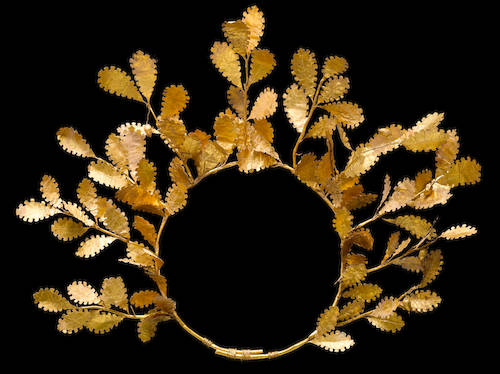
The London auction house Bonham's is going to auction (Sale 17822, 28.04.2010) a gold wreath similar to that found in the excavation of Vergina. Auction on the 28.04.2010 and 29.04.2010.
 This stunning artefact, estimated £100,000 - 120,000, may once have graced the head of a ruler or dignitary over 2,000 years ago. “The fact that this delicate collection of fine gold leaves and acorns formed into a wreath has survived the centuries is almost miraculous,” says Madeleine Perridge, Antiquities Specialist at Bonhams. Previously in a private collection since the 1930s, “it is a beautiful example of a type that is rare to the market.”
The item then has a supposed provenance of an old collection of the 1930s, which if true will impede any efforts to reclaim the item.
The new Greek Directorate of Illegal Commerce of Antiquities of the Ministry of Culture is working on the case and has asked Bonhams for detailed photographs and the exact provenance of certain pieces.
Apparently three unnamed Greek archaeologists ("specialised in ancient jewellery from Northern Greece"), judging from the photographs of the crown were wary of its authentisity, but also of its "Macedonian" provenance. The type and make of the oak leaves caused doubts, despite "the size and shape being identical to the well know royal crowns". Their only conclusion was that only a macroscopic examination could lead to certain conclusions. (N. Kontrarou-Rassia, Eleutherotypia, 09.04.2010).

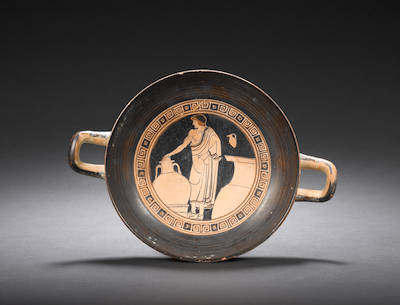
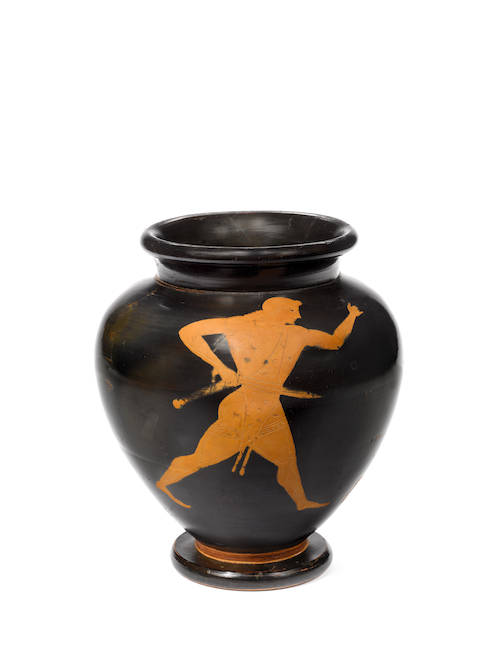
The same auction will see the sale of a fine collection of attic vases, including an Attic red-figure stemless kylix by Douris, circa 480 B.C. showing a draped youth with defined musculature, standing in an Athenian wine-shop amongst large amphorae, (estimate £30,000-40,000). Exhibited in the Fogg Art Museum at Harvard from 1937, this drinking cup is a fascinating image of Athenian life in the Classical period. Provenance given in catalogue: "Ex Professor Jakob Rosenberg Collection, Cambridge Massachusetts, 1937. Property of a private English collector. Acquired from Sotheby's New York, May 30th 1986, lot 19." This one at least has an early provenance (1937), something that is definetly not the case for many of the items in the sale...

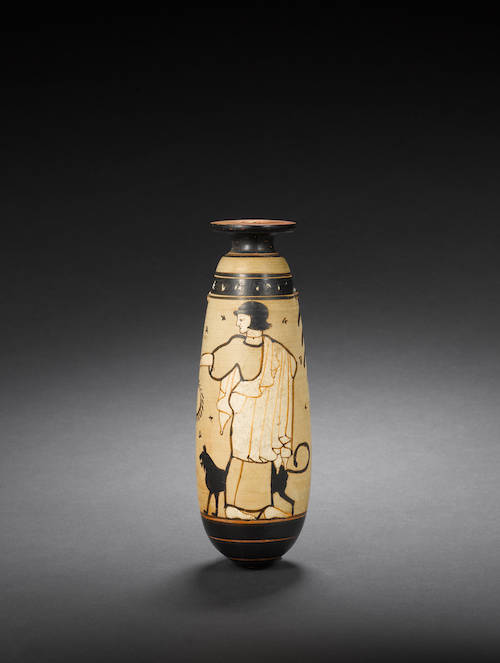
An unusual intact Attic white-ground alabastron of the group of the Negro Alabastra, (circa 490-480 B.C.) showing a female figure walking to the right and turning to look back, draped in a chiton with himation and wearing a necklace and bracelet, holding a wreath in her right arm. A black lion walks behind her, with a palm tree on the far left, the word 'KALOS' (beauty) inscribed three times around the figure. Estimate £30,000-50,000. The name Melanphis Kale can be translated as 'Black Flower'. Such alabastra were given as love gifts and the frequent use of 'Kalos' supports this.
Details concerning the provenance given in the catalogue: "Provenance:
Property of a private English collector. Acquired at Christie's London, 28 April 1993, A Private Collection of Important Greek Vases', lot 29 where the collection is described as 'well known to J.D. Beazley'.
Exhibited:
The Ashmolean Museum, Oxford from 2001 to 2009. This lot is accompanied by its Ashmolean display card." Yup, yet another piece from an unnamed Priavate English Collection - well known to Beazley! Earliest date mentioned: 1993!

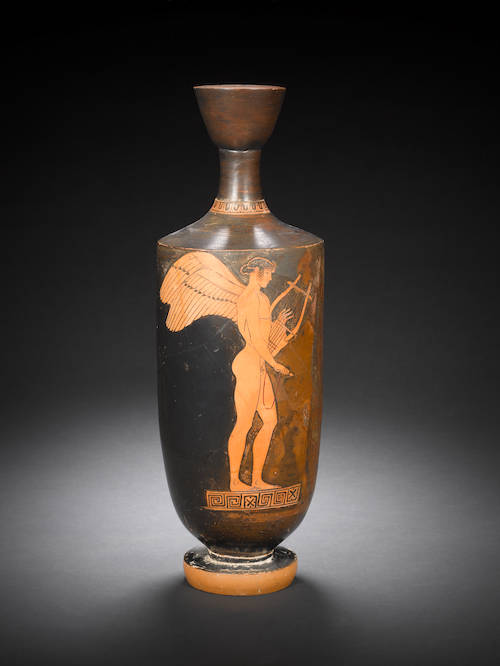
An Attic red-figure lekythos finely painted by the Providence Painter, (circa 5th Century B.C.) depicts the god Eros as a young man, standing nude, in profile to his left, his wings behind him, holding a kithara in his left hand, a plectrum on a red ribbon in his right.
Estimate £25,000-35,000Details given in the Bonham's catalogue: "Property of a private English collector. Previously acquired at Sotheby's London, 13-14 December 1982, lot 84. Exhibited: The Ashmolean Museum, Oxford from 2001 to 2009. Published: Archaiologikon Deltion, vol. 36 (1981), p.1, pl.56B. For a similar work by the Providence Painter, cf. T.H. Carpenter, with T. Mannack, & M. Mendonca, Beazley Addenda, 2nd edition (Oxford, 1989)p. 274." Yet another piece from a private Enlish Collector! Earliest date it is mentioned? 1981.
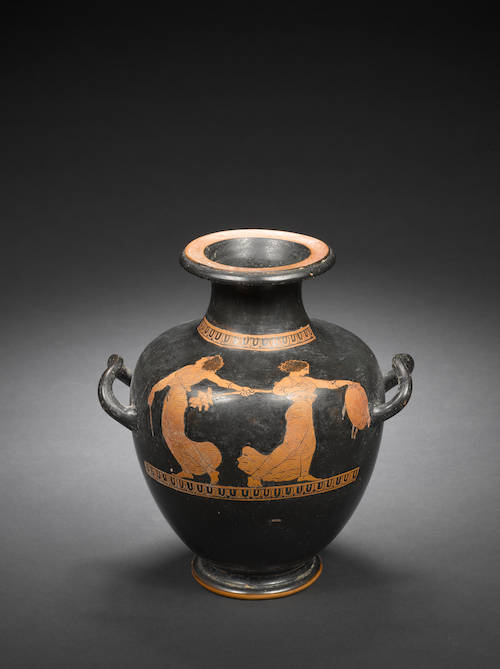
 An Attic red-figure hydria in the manner of the Medeia Painter, (Circa 420 B.C.) depicts two Maenads draped in clinging diaphanous chitons, dancing away from each other while holding a number of ritual objects. It is estimated to sell for £25,000-35,000. The provenance given in the Bonham's catalogue: "Property of a private English collector. Acquired at Christie's London, 28 April 1993, A Private Collection of Important Greek Vases', lot 29 where the collection is described as 'well known to J.D. Beazley'. " Meaning its history starts in 1993!!

An unusual Attic stamnos painted in the rare Six technique, from the workshop of the Antimenes Painter, circa 510 B.C. showing Theseus and the Minotaur with Ariadne. Estimated to sell for £150,000-250,000, it was previously in the Ferrucio Bolla Collection in the 1950s and the Stavros S. Niarchos Collection, and it has been exhibited at the J. Paul Getty Museum, Malibu, in 1980.
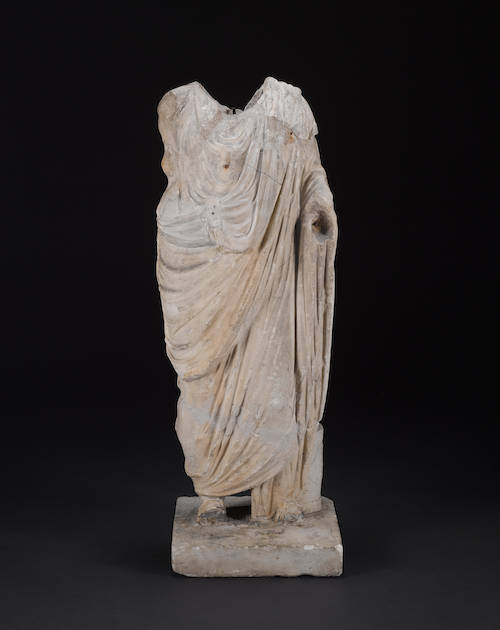
 Lot 138
. A Roman marble statue of a Togatus
Circa 1st-2nd Century A.D.
Provenance given in Bonham's Catalogue:
"
Ex UK collection until 2008. Acquired on the Paris art market in 2009." That's interesting...Yet another unnamed Private UK collection! Earliest provenance date:
2008!!
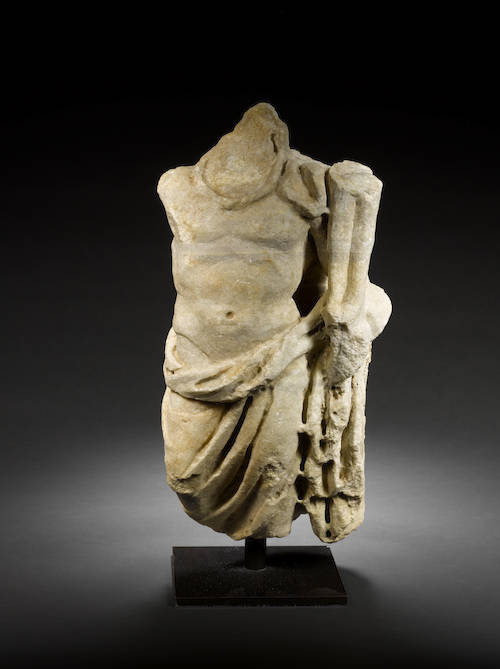
 Lot No: 143
 A Roman marble male torso
Circa 2nd Century A.D.
Provenance given: "Ex European private collection, acquired by the present owner prior to 2000." Wow! How vague is that? A private "European" collection, that acquired the piece ten years ago? That does sound cozy!
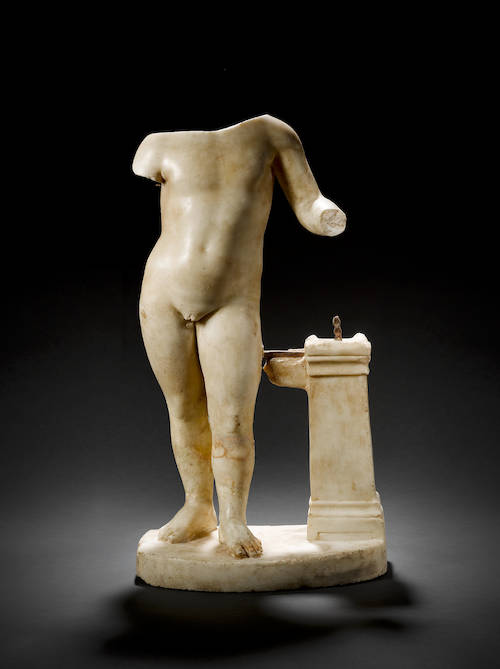
 Lot No: 137W
 A Roman marble figure of a youth
Circa 1st-2nd Century A.D.
Standing naked, the weight on his right leg, his left leg relaxed, supported by the column and strut on his left, standing on an integral base, 27in (68.6cm) high
Estimate: £20,000 - 30,000 Footnote:
Provenance:
Acquired at Sotheby's London, 8th-9th December 1986, lot 287.
Literature:
Probably depicting a young satyr or Apollo, cf. M. Bieber,
The Sculpture of the Hellenistic Age, (New York, 1955), figs. 18 & 86.

...and here is a polaroid of the same statue. It is one of the polaroids illustrating what past through the hands of Giacomo Medici that were confiscated during the raid on the warehouses in the Geneva Freeport. See:
Looting Matters, 21.04.2010.
In a word, browse through the catalogue and you will find that every other piece has a provenance that does not stand up to scrutiny. Even if we take the given dates linked with the provenance at face value (although of the older ones many are vague and usually linked to "[unnamed] private collections of the 1930s"), most are way after the generally accepted "truce" date of 1970 (the date of the UNESCO Convention), meaning that there are gaping gaps concerning the items history, including the date and place of discovery and the circumstances of its export from the country of origin.
Of course, as is common practice in the Antiquities Commerce, Bonham's, by giving no place of origin hopes to confound any challenges to its right to sell the items: if the challenger cannot prove the country of origin, there is no way the item can be reclaimed by a particular country.
And of course the end-loser is scientific knowledge, as the objects ripped from their archaeological context offer very little to research, compared to what would have been gained if we possessed their full data.
Sources: