 |
| Map of Macedonia marking principal sites and the marble quarry of Aliki on the island of Thasos (made with Google Earth). |
Once again Greek media are publishing information concerning the Toumba Kasta located near the village of Mesolakkia, to the North-East of ancient Amphipolis. We have already discussed this important funerary monument a couple of years ago. In summary the archaeological data is as follows:
a. An enclosure (perivolos wall) of almost 500 m. diameter (497 m to be exact), unique among Macedonian tombs.
b. Two statues of Sphinxes, on either side of the door, which was served by a large (4.5 m wide) dromos (road)
c. The "Lion of Amphipolis", of a height of 5.25 m itself, is now, apparently, definetly attributed (by the architect mr Lefantzis) to this monument, its original position being at the summit of the tumulous.
d. According to mrs Peristeri, the excavator of the site, the monument "bears the signature of the famous architect and friend of Alexander, Deinokrates". It is not clear from the Greek statement whether this means that an inscription bearing the name if Deinokrates has been discovered, or whether it means that the monument is in his style...
e. Mrs Peristeri dates the monument to "the last quarter of the 4th century", i.e. 325-300.
f. The marble used for the perivolos comes from the neighbouring island of Thasos, and specifically the quarry of Aliki (Αλύκη). This means that the large blocks were transported by sea, an expensive and difficult operation.
It should be noted that the first archaeological excavations were carried out by Dimitris Lazaridis between 1965 and 1985; excavations restarted in 2009.

 |
 |
| The PM Antonios Samaras being guided around the site (photos: Ptoto Thema) |

 |
      .jpg)   |


 | ||
Views of the perivolos of the Toumba Kasta published in Greek media. |
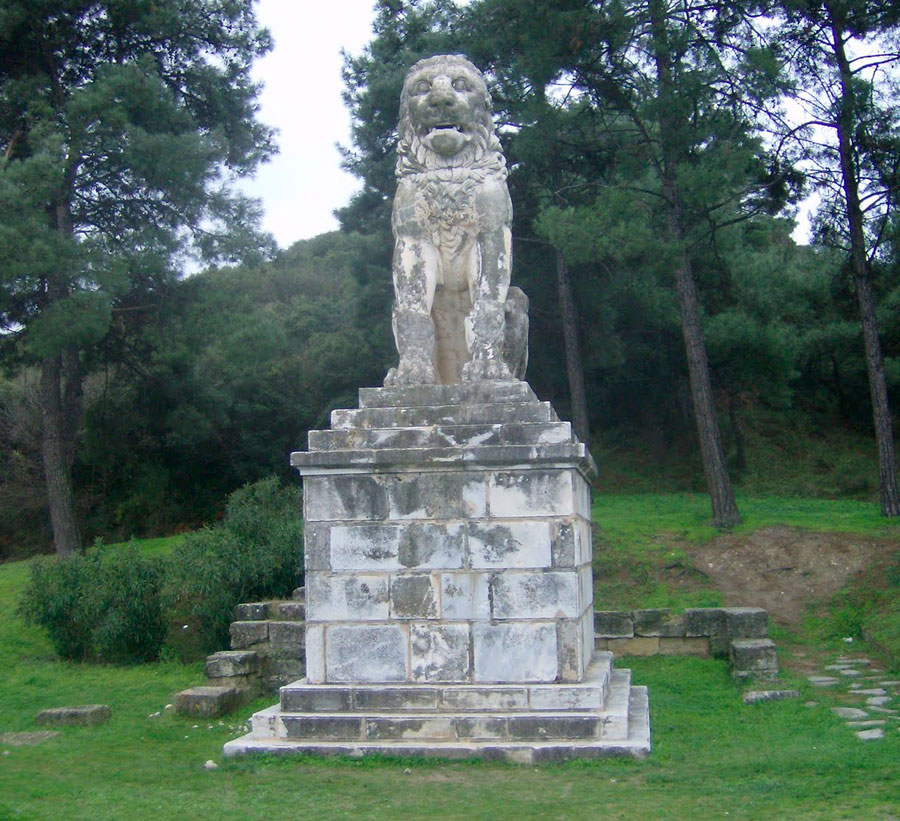 |
| The "Lion of Amphipolis" as it stands today. It is said to be the sema of the tomb, having stood on the summit of the tumulous. |
Parts of the monument have been known since 1912, when Greek troops sent a report mentioning the lion and parts of its base. The lion itself had various adventures during the 20th century, being moved a number of times, including by British troops in 1916 who tried to smuggle it out of the country, but whose attempt was foiled by impudent Bulgarian troops, who seemed to believe that fighting a war was more important than enriching the collection of the British Museum...
In all the visit of the Greek PM, Antonios Samaras, to the site and his declaration that it is "an extremely important find", has excited all sort of speculation.
Using existing data we can postulate the following hypotheses:
1. The tomb was meant for the body of Alexander, but was left empty as the body was hijacked by Ptolemy and buried in Alexandria, Egypt. This would be consistent with the narrative of ancient sources.
2. The tomb belonged to members of Alexander's family (Roxane, Alexander IV).
3. The tomb belonged to a member of Alexander's court, a close collaborator, general etc. Candidates here would include the admiral Leosthenes of Mytelene and the admiral Laomedon, a long-time friend of Alexander (who had been exiled by Philip II for plotting with Alexander to overthrow him, and who, for a short time was one of Alexander's successors).
4. A number of archaeologists and historians have advances a number of arguments against the attribution of the great tomb at Vergina to Philip II. If they are right, and the Vergina tomb is to be attributed to, say, Alexander IV, then the tomb of Philip has yet to be found. Given the size and apparent splendour of this tomb, as well as its approximate dating, would allow us to postulate that Alexander might have ordered his architect Deinokrates to build his illustrious father a fitting final resting place. The problem with this thought is, of course, once again that the tomb is NOT at Vergina, i.e. the royal cemetery...
5. The tomb belonged to Alexander himself. This is the most unlikely scenario. Not only does it go against the information of ancient sources that state that Alexander's body was taken to Alexandria and preserved in a special tomb that was accessible to special visitors (several Roman Emperors have been recorded as having visited the site and viewed the body), but it is also hard to believe that such an important monument would have been pillaged during the Roman era, and material from it taken and used for other purposes as apparently happened.
Anyway, the good news is that the digs will continue, as fresh funding of 100.000 Euros has just been announced. Lets be patient and see what shall be revealed from this uncontestedly magnificent monument!
Sources:
- Archaiologia.gr, 01.04.2013, "Το Λιοντάρι της Αμφίπολης αγναντεύει την αρχική του θέση στον Τύμβο Καστά", here
- Dimokratia, 01.09.2013, "Το μυστικό του τάφου και τα «σφραγισμένα» τείχη της Αμφίπολης!", here.
- Kathimerini, 12.08.2014, "Σαμαράς: "Εξαιρετικά σημαντικό εύρημα" στην Αμφίπολη", here.
- Proto Thema, 12.08.2013, "Σαμαράς από Αμφίπολη: «Είμαστε μπροστά σε ένα εξαιρετικά σημαντικό εύρημα», here.
- Proto Thema, 12.08.2013, "Ο τάφος της Αμφίπολης: Τα στοιχεία που τον κάνουν μοναδικό", here.
- Proto Thema, 12.08.2013, "Δείτε εντυπωσιακές φωτογραφίες από τα ευρήματα στην Αμφίπολη", here.
- Proto Thema, 20.08.2014, "Στο φως οι Σφίγγες της Αμφίπολης 2.300 χρόνια μετά", here.


