Turkey: In Cappadocia Archaeologists discovered a huge mosaic and the Greek inscription "if you are healthy, enter".
Original Greek title: "Τουρκία: Αρχαιολόγοι ανακάλυψαν στην Καππαδοκία τεράστιο ψηφιδωτό και την ελληνική επιγραφή «αν είσαι υγιής, μπες»", Πρώτο Θέμα, 07.11.2023.
As part of
the excavations, new mosaics were uncovered in a 33-room villa, which is
estimated to have been built in the 4th century AD.
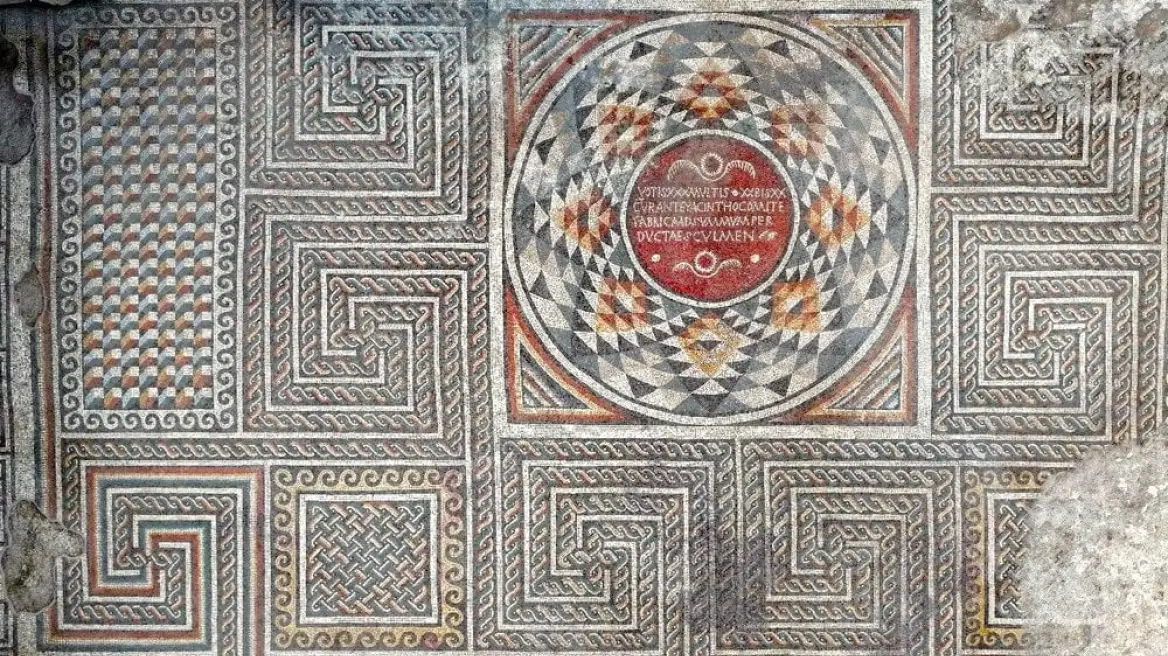
Discovery in the area of İncesu in Caesarea
during excavations.
In the centre
of Turkey, in a villa with 33 rooms, a construction with the largest floor
mosaic was found, and parallel walls were discovered with the Greek
inscription: "If you are healthy, enter" were found inside the space.
Specifically,
as part of the excavations that continued this year, new mosaics were uncovered
in the villa, which is estimated to have been built in the 4th century AD.
The
Director of Culture and Tourism of Caesarea (Kayseri ) stated that the
excavation started three years ago and that every year more and more surface is
revealed. "The initial estimate of the area where the mosaic is located
was 300 square meters and now it has reached 600 square meters," he said.

Excavations
continued on an area of about 4 thousand square meters. “We came to the
conclusion that this place was built in the 4th century. According to the finds,
there are also traces dating from the 3rd century onwards. The quality
technique used in the floor mosaics indicates that this place was a very
important villa at the time" emphasized the Director of Culture.
“In the
space identified as the banquet hall, a Latin inscription was found. In
addition, Greek inscriptions were also discovered. There are mostly
geometrically decorated mosaics," he added. Excavations have come to an
end for this year, but are expected to continue next year.
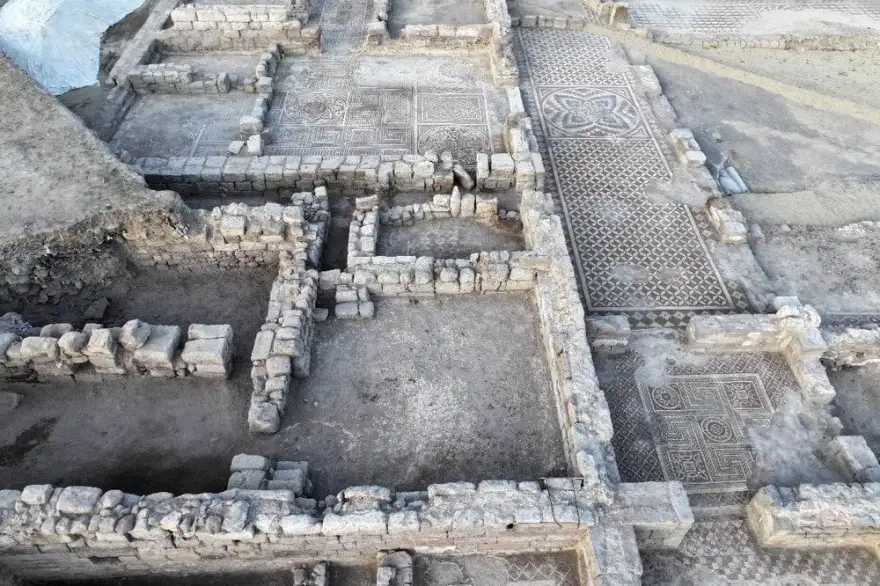
The person
in charge of the excavation project stated that the structure continued to be
used during the Byzantine period and after the arrival of the Turks in
Anatolia.
The mosaics
first came to light during archaeological restoration work in 2010. After two
excavations (2010 and 2012) that partially revealed the mosaic inscriptions,
some legal issues forced the suspension of archaeological work. Excavations
started again in 2020 and by the end of 2021, more than 10 rooms with around
300 m2 of continuous mosaic floors that were in excellent condition had
been uncovered. This year's excavations have doubled the area of the mosaic,
which now reaches approximately 600 square meters. So far, approximately 4,000
square meters of the site have been excavated.
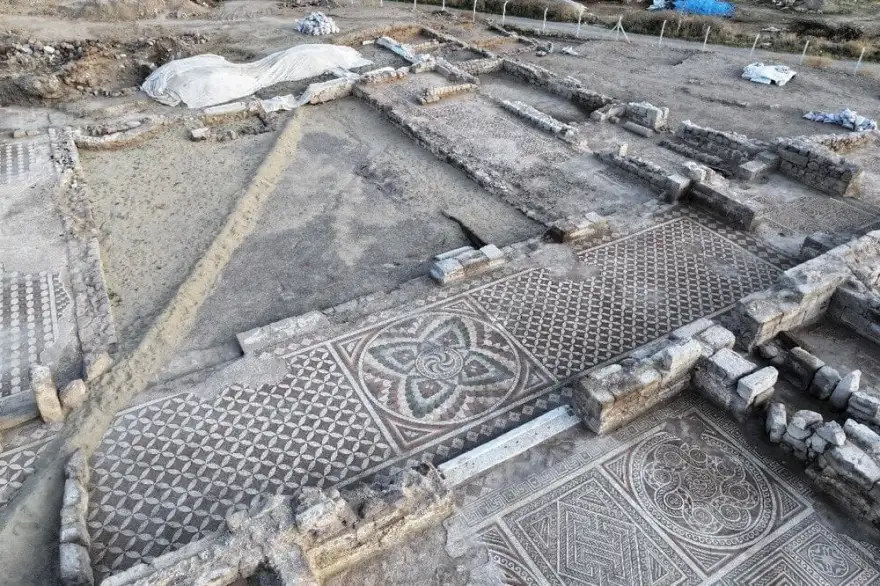
The Latin
inscription states, among other things, that the building was erected under the
direction of Count Hyacinthos. Count was a title awarded to officials of the
imperial court. But nothing is known of an official named Hyacinthos recorded
in this inscription.
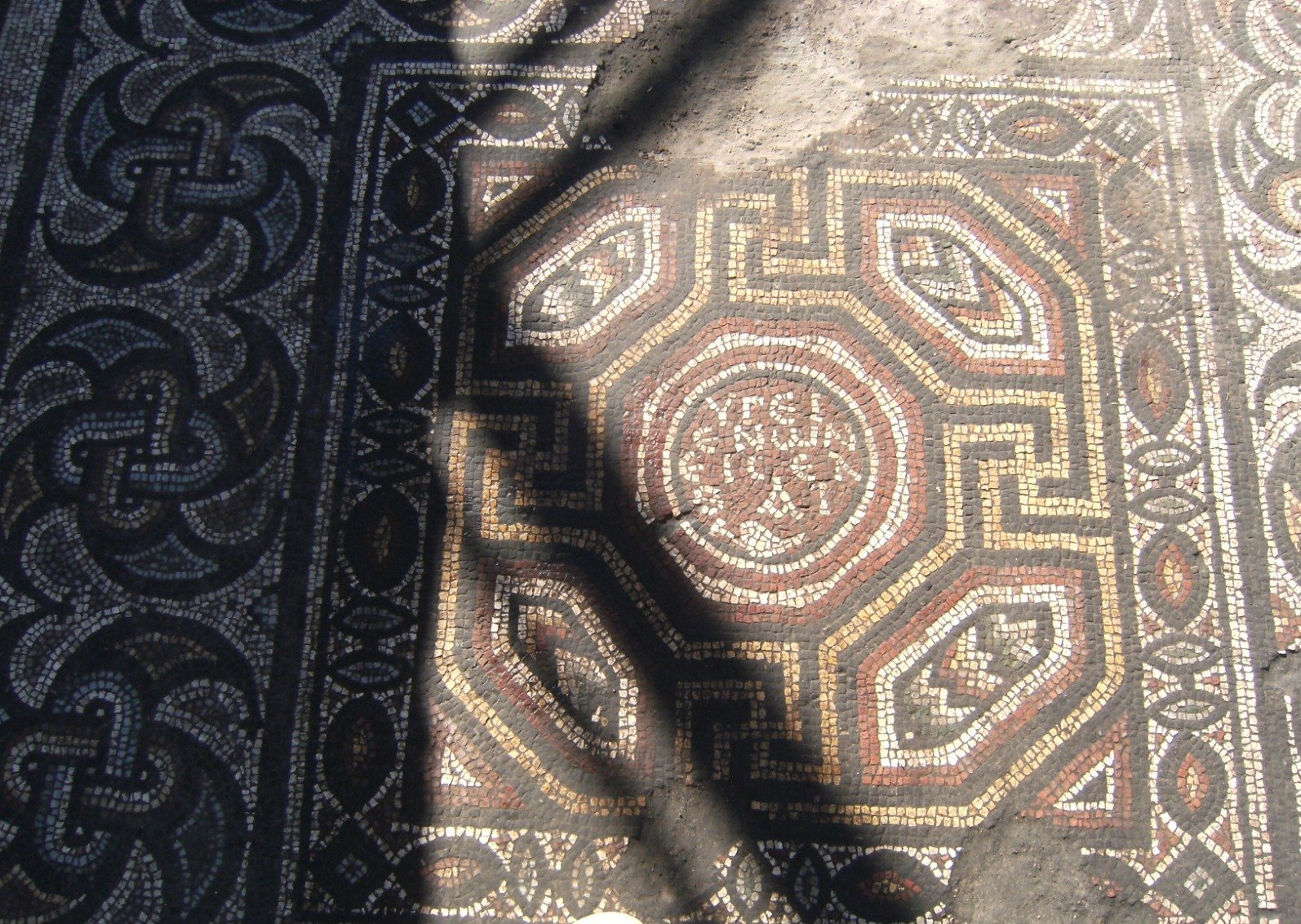
Another, much shorter inscription in a smaller
adjacent walled room is in Greek and reads: "If you are healthy,
enter." This could refer either to physical health, or, if the building
had a religious purpose, it could be a condition that all who were allowed to
enter the premises had to be mentally healthy.
For more information and images see:
https://www.raillynews.com/2023/11/Mosaics-in-%C4%B0ncesu-illuminate-the-history-of-Kayseri/
https://www.thehistoryblog.com/archives/68762
https://news.artnet.com/news/largest-known-4th-century-floor-mosaic-uncovered-in-turkey-2395605
https://www.thisiscolossal.com/2023/11/anatolian-mosaics/
https://www.dailysabah.com/arts/largest-byzantine-mosaic-structure-found-in-central-turkey/news
(for the image of the Greek inscription)
Notes by ArchaeologyMatters:
Although I
only have knowledge of the discovery through the press, there are some
conclusions that we can draw.
As for the Latin
inscription, it appears to read:
VOTIS XXX MVLTIS * XX BIS XX
CVRANTE YACINTHO
COMITE
FABRICA AD SVMVM
PER
DVCTA ES CVLMEN
1. For the vows on the thirtieth
anniversary of the rule of the emperor, and more (vows) for (another) twenty
years, and twenty more years again.
2. While Hyacinthos, holding the office of
count, was governing,
3. building, up to the roof
4.
you were delivered.
VOTIS -
Votis (Decennalibus) : Vows/Prayers for 10 years of rule
CVRANTE =
Curante: While (he) was governing
YACINTHO:
Yakinthus
COMITE:
count
PERDVCTA - perducta: conducted,
delivered
FABRICA: A skillful production, fabric, building,
structure.
CVLMEN -
culmen: top, roof, summit (cf. culmination)
The Emperor
implied in the first line is probably Constantius (Κωνστάντιος)II – 317-361 (cf. his coin: https://commons.wikimedia.org/wiki/File:Constantius2cng10400876.jpg).
This appears to be consistent with dating given in the article.
 |
| https://upload.wikimedia.org/wikipedia/commons/1/1a/Constantius2cng10400876.jpg?20200831172840 |
The name YACINTHO is Greek (Υάκινθος). In mythology this was a lover of Apollo, whom the god killed accidentally. The Spartans celebrated a festival called the Yakintheia during a month called after him (Μηνός Υακινθίου) that corresponded to the Attic Ἑκατομβαιών (May-June). Interestingly the latinised form here remains closer to the Greek (not “Hyacintho”).
The Greek
inscription:
ΥΓΕΙ
ΕΝΩΝ
ΕΙCEΛ
ΘΑΙ
Ὑγιένων (sic) – Ὑγιαίνων (;): Definition:
to be sound, healthy - Usage: I am well, am in good health; I am right,
reasonable, sound, pure, uncorrupted.
Note the spelling Ὑγιένων instead of the more usual Ὑγιαίνων. This obviously attests to the pronunciation of the word in the 4th c. AD, although y this time even the most hard-line accepts that the pronunciation had evolved. Conversely it is interesting that the author of the work chose this unconventional spelling.
Είσελθαι: εἰσέρχομαι
to go into,
enter, invade
(of the
chorus or of actors) to come upon the stage, to enter
(as an
Attic law term, of the accuser) to come into court
(of the
parties, with accusative) to enter upon the charge
(of the
accused) to come before the court
(of the
cause) to be brought in
to enter on an
office
Interestingly, we also find Υγιαίνων as the name of an official of the Kingdom of Bosporus in the 3rd century BC, as attested by coins.
 |
| Πηγή: https://el.wikipedia.org/wiki/%CE%A5%CE%B3%CE%B9%CE%B1%CE%AF%CE%BD%CF%89%CE%BD_%CF%84%CE%BF%CF%85_%CE%92%CE%BF%CF%83%CF%80%CF%8C%CF%81%CE%BF%CF%85#/media/%CE%91%CF%81%CF%87%CE%B5%CE%AF%CE%BF:%D0%97%D0%BE%D0%BB%D0%BE%D1%82%D0%BE%D0%B9_%D1%81%D1%82%D0%B0%D1%82%D0%B5%D1%80_%D1%86%D0%B0%D1%80%D1%8F_%D0%93%D0%B8%D0%B3%D0%B8%D0%B5%D0%BD%D0%BE%D0%BD%D1%82%D0%B0.jpg |
cf. Elena Stolyarik. THE REIGN AND CHRONOLOGY OF THE ARCHON HYGIAENON. Leucon of Bosporus.
In our case the "ΥΓΕΙΕΝΩΝ ΕΙCEΛΘΑΙ" is probably a formula of blessing "Come in and may you be in good health" (cf. the modern "Γειά σου" - "Το your health"), rather than the conditional proposed in the article that has led to the accompanying hypothesising.
For similar formulations (and other examples of the spelling with an "E", see Anna Avramea, Le Péloponnése du IVe au VIIIe siècle. Changement et persistances, Publications de la Sorbonne, Paris 1997, p. 145-155, that reproduces the examples collected by L. Robert, Bulletin épigraphique 1976, 751: "ὑγιαίνοντες ἀπ[ολαύετε] (Salamine de Chypre) ; ἐν ὑγίᾳ λουσάμενος ἀπολαύσιας (Jérusalem) ; εὕχεσθαι οῦν οἱ ἀπολαύοντες (Zénonopolis). Cf. en dernier lieu, J. Russel, The Mosaic Inscriptions of Anemurium, Vienne 1987 (Ôster. Akad. der Wiss., Philos.-Hist. Klasse, Denkschriften 190), p. 33 : ]υγιένων λούσε".


