Showing posts with label Commerce of antiquities. Show all posts

Thursday, 26 January 2012

Marble lion confiscated in Central Greece


Three Greeks tries to sell a marble lion of the 5th-4th c. B.C. for 500.000 Euros. The three smuglers were arrested in Itea (Phokis, Central Greece) by officers of the Deparment against antiques smuggling, shortly before their appointment with a would-be buyer. The marble lion was 110 cm long and 30-35 cm wide and had probably served as a grave-marker in antiquity. According to an achaeologist of the Ministry of Culture, it is an object of great value that is subject to the law "on protection of antiquities and generally of cultural heritage".

Source: Ta Nea, 16.01.2012.

Tuesday, 19 July 2011

Eqypt's Antiquities Boss Is Sacked

Eqypt's Antiquities Boss Is Sacked

on 18 July 2011, 3:29 PM

From: Science Insider, 18.07.2011


After nearly a decade as chief of Egypt's antiquities, Zahi Hawass is now out of a job.

The 64-year-old archaeologist was fired yesterday by Prime Minister Essam Sharaf as part of a wider shakeup of his cabinet. Protestors at Cairo's Tahrir Square had been calling for his ouster as minister of antiquities for months. "All the devils united against me," Hawass told Science Insider.

The country's most prominent figure in archaeology, Hawass was instrumental in sending large blockbuster exhibits abroad, creating a host of new museums and secure storerooms, and pressuring foreign excavators to publish their finds more quickly. But he was also criticized for his portrayal on American television of archaeology as treasure hunting, excoriated for his dictatorial management style, and accused of shoddy research in carrying out his own digs. Sharaf is said to have appointed Abdel-Fattah El-Banna as Hawass' replacement, but there are reports that protestors have rejected that nomination, and that Sharaf might reverse his decision and name someone else.

El-Banna is an engineer and stone specialist at Cairo University with experience in restoring ancient buildings. He has been an outspoken critic of Hawass in recent months, accusing him of being involved in the illegal antiquities trade, a charge that Hawass denies.

Egyptian critics say they are delighted by the departure of Hawass, who became a minister in January when the Supreme Council of Antiquities (SCA), the organization he has led since 2002, was given Cabinet status. "Finally we got rid of him," says Amany Taha, a Cairo tour guide active in the protests.

But some foreign archaeologists say they will be sorry to lose Hawass, who has been a dynamic if controversial leader of the country's ancient monuments. "In the ensuing free-for-all, now that he is gone, I beg you to remember all the good that Zahi did for Egypt and Egyptian antiquities in his term as SCA," says W. Raymond Johnson, an archaeologist of the University of Chicago in Illinois who works at Luxor. "It's easy to condemn, much harder to give credit for what is due."

Hawass resigned in March to protest the looting of sites, but was recalled to help bring tourists back to Egypt. For now, Hawass says, "I will rest."

Zahi Hawass: the 'Real Indiana Jones'

Zahi Hawass was the self-styled real Indiana Jones, calling himself the keeper of Egypt's heritage.

From: The Telegraph, 18.07.2011

Mr Hawass, the public face of the pyramids, was head of the Egyptian Supreme Council of Antiquities for 10 years, and before that in charge of the Pyramids and Sphinx on the Giza plateau outside Cairo.

He staged regular press conferences unveiling new discoveries from the time of the pharaohs. He was made minister of antiquities in one of Hosni Mubarak's last acts as president.

Dr Hawass was popular among journalists, visitors and for a time Egyptians themselves for his flamboyant style and unchallenged commitment to promote Egypt's treasures and to use them to attract tourists.

He also led populist campaigns to return Egypt's heritage from museums abroad, most notably the Rosetta Stone from the British Museum.

However, local archaeologists accused him of stealing credit for their achievements, and "recycling" discoveries for publicity.

More seriously, as the Egyptian revolution unfolded, his finances, friendship with Mr Mubarak's wife, Suzanne, and management of resources came into question.

He was revealed to receive a regular income from the National Geographic channel, and was put on trial over the contract under which a company which marketed a "souvenir Hawass clothing line", including copies of the trademark hat, was awarded the rights to run the souvenir shop in the National Museum in Cairo.

He claimed that proceeds from the hats went to children's charities, of which Mrs Mubarak was patron.


Memorandum against Illegal Commerce of Antiquities


Memorandum against Illegal Commerce of Antiquities

Foteine Mparka, Eleutherotypia, 18.07.2011

Finally a memorandum that protects us (t.n.: the reference is to the economic memorandum). Since yesterday afternoon Greece has a strong ally in the battle against illegal exportation of its antiquities.

The American Foreign Minister and her Greek counterpart Stavros Lambinides, sign the memorandum in the Parthenon room.

For almost 10 years high ranking officials from the Greek ministry of Culture tried insistently to convince the United States to sign a Memorandum of Understanding for the limiting of importation of cultural goods of greek origin.

Yesterday afternoon , in the Parthenon room of the new Museum of Acropolis, the foreign affairs minister, Hillary Clinton, signed the text with her Greek counterpart, Stavros Lambrinides; they even went a step further. It is the most extensive text of collaboration that the USA has signed with another country and includes works of art dated from the Upper Palaiolothic (c. 20000 B.C.) to the end of the Byzantine period (15th c. A.D.).

Legal documentation

But what does this collaboration between the two countries mean? No object unearthed in Greece will be imported to the US unless accompanied by relevant legal documentation of origin. This makes illegal commerce of greek antiquities more difficult, but also makes the procedure of return of antiquities to the country. Will the interstate agreement have retroactive character? What shall be the fate of antiquities that have already been illegally exported to the US? Before examining the actual text, no conclusions can be drawn.

Whatever the case it will by activated immediately. The next move of the ministry of Culture will be to send the catalogue of categories of antiquities (analytically described) that has already been compiled, so that it be published in the Federal Protocol of the US, so as to block their importation to the country.

Satisfaction was apparent yesterday on the faces of the officials of the Ministry of Culture. The effort had started during the term of Evangellos Venizelos as Minister in 2002. It was then that a special scientific committee to prepare the dossier. The procedure entered its final phase during this last year, when a group of Greek specialists was invited by the special committee of the US State Department in Washington to support the Greek request. Before sending its official request, the Ministry of Culture compiled a dossier that showed how the cultural heritage of the country was in danger from illegal digs and commerce. The General Secretary of the Ministry, then as today, was Lina Mendoni, who was present at the signing ceremony, as was the current Minister of Culture, Pavlos Geroulanos.

"This agreement that we are signing today will protect Greece’s culturally significant objects even further from looting and sale on the international market... We know from experience that measures like this work. This will be our 15th cultural property agreement. And in countries from Cambodia to Cyprus, we have seen real results.", underlined Hillary Clinton during her short speech.

Profitable Business

The commerce of Greek antiquities in the US continues to be an especially lucrative business, with a turnover of millions of dollars. For example, in only the six months of 2010 Sotheby's and Christies of New York, auctioned more vases that the total of the years 2005, 2006 and 2009. What is more, Internet's ebay has helped create a rapidly developing uncontrolled commerce.

The Memorandum of Understanding, know by its initials MOU (Memorandum of Understanding), was instituted in 1983 by the American Congress. The central part of each memorandum is the interdiction of importation of antiquities without proper documentation. In order to sign and apply the Memorandum, a Committee was formed
, called the Cultural Property Advisory Committee (CPAC).

See also:

State Department Page on Agreements
US-Cyprus Memorandum
US-Italy Memorandum

Sunday, 17 July 2011

Antiquities smuggler arrested (Kastoria & Florina, Greece)

17.07.2011: Antiquities smuggler arrested

ANA-MPA/A 48-year-old man from Florina, northwestern Greece was arrested on Thursday charged with antiquity smuggling.

The suspect, while driving his car near Vassiliada village in Kastoria prefecture, was stopped by a police roadblock. A search of his car and later of his house in Florina revealed a large number of Roman and Byzantine era coins, other antiquities and photos believed to indicate locations where antiquities are buried.

Specifically, police found and confiscated 81 ancient coins, two marble statues from the Hellenistic period, the head from a female statuette, two copper rings, a lecythus, a medal, six clay seals, four copper brooches, two metal detectors, one perfume container, two USB flash drives and eight photographs of probable sites of antiquities.


From ana-mpa

Saturday, 3 July 2010

Antiquities seized in the Republic of Macedonia (F.Y.R.O.M.)

In the Republic of Macedonia, in an action named “Phalanga”, police has seized a great number of antiquities destined to be sold illegally or smuggled abroad (Greece, Italy, Austria, with the obvious final destination being the auction houses in Western Europe and the US). The antique objects seized came from illegal digs. Media reports talk of 48 people being under preliminary interrogation by the police and that 28 (according to some reports 23) arrested. Some of the persons involved were high-ranking officials, although no names have yet been released. The reports speak of municipal counsellors, museum directors, well-known businessmen and even police officers. This is the biggest action of this kind in the country and the authorities say that there are enough items to fill a museum.


The objects date from the Iron Age, up to the 19th century. Among the items, there are bronze figurines of a Pegasus, of a Menade, of a small child holding a cup, a marble phallus, a large number of coins (according to some authorities about 3000 and most of them dating from roman period) and several Byzantine icons. In a private house a headless roman statue and several Byzantine capitals were found.


Sources:


A1 television (internet site):

- 24.06.2010

- 24.06.2010
- 28.06.2010 (Video)

Dnevnik:

- 24.06.2010

Utrinski Vesnik
:
- 26.06.2010
- 28.06.2010

Saturday, 15 May 2010

Archaeology Matters Strikes!


Recently David Gill of Looting Matters published a polaroid from the Giacomo Medici Archive. Just hours after the article was published, Archaology Matters struck a blow with a one line comment: "...and is now in the Bonham's sale (lot 137)".

By April 27 the lot was withdrawn from the Bonham's sale and David Gill was writing on the subject again, as were others. It even left the blogosphere in an article published by the Guardian, 27.10.2010.

It is a pity no one thought to mention our contribution, which may have been quantitatively small, but was certainly the key to the affair....

This is not to take any of the credit from David Gill and the excellent work he does with Looting Matters (and not only..!).

..................................................................................................................................................

EDIT:

Please see the comments. All credit is rightly attributed to David Gill of Looting Matters. For all his work I can but once again congratulate him!

Giacomo Medici Polaroids

The September 1995 raid on the Geneva Freeport premises of Giacomo Medici brought to light a major archive of some 4000 photographs. These images, some Polaroids, have been used by the Italian authorities to identify objects that have passed into public and private collections. (Looting Matters)

SCULPTURE


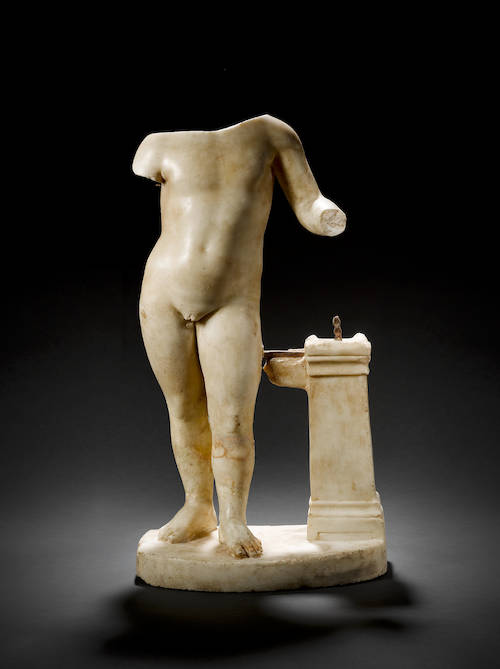
Roman Marble Figure of Youth.
1st-2nd c. A.D.
27in (68.6cm)
Standing naked, the weight on his right leg, his left leg relaxed, supported by the column and strut on his left, standing on an integral base.

APPEARED:


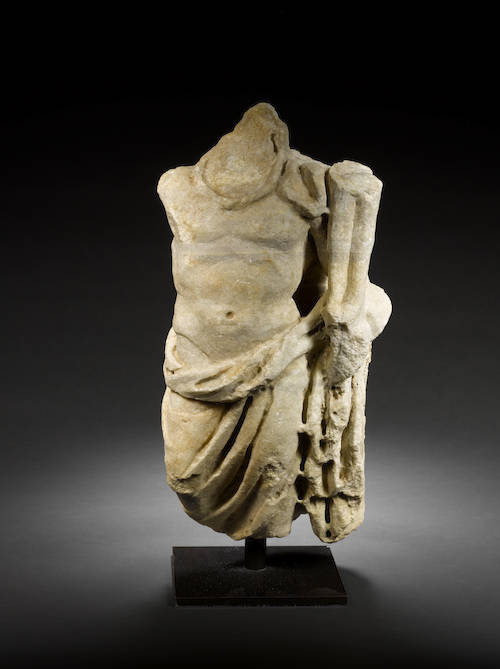
Roman Marble Torso of Youth, holding cockerel.
c. 2nd c. A.D.
24 in. (60.9 cm.) high.
Depicted nude, standing in contrapposto with his weight originally on his left leg, the right leg relaxed, his torso twisting with his right shoulder slightly forward, holding a cockerel in his left arm, his hand at the bird's left wing, its tail feathers curving along the contours of the boy's hip, remnants of a strut along his right thigh, a fragment of a support preserved along the back of his left thigh.

APPEARED:
Christie's, New York, 10.06.2010, 139.

SEE:
Looting Matters


TERRACOTTAS


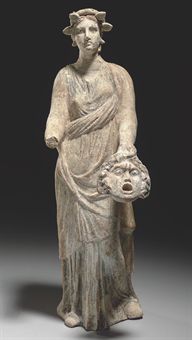
A GREEK TERRACOTTA FEMALE CANOSAN, HELLENISTIC PERIOD, CIRCA 3RD CENTURY B.C.
17½ in. (44.4 cm.) high
Standing with her weight on her right leg, her left bent at the knee and pulled back, wearing a peplos and a himation draped over her left shoulder and around her torso, her arms lowered with her forearms projecting forward, holding a mask of Medusa in her left hand, the right missing, a thick fillet with radiating leaves in her center-parted hair, preserving traces of pigment, including black, white, blue and pink


APPEARED:
Christie's, New York, Sale 2323 (10.06.2010), lot 110.
(Given Provenance: Japanese Private Collection, 1980s.)
SEE:
Looting Matters here and here.


CERAMIC

Attic
  • Bonham's, 10.2008, 6: Attic black-figured column-krater. Surfaced: Sotheby's London, Antiquities, July 13th-14th, 1987, lot 440. (Source: Looting Matters)
  • Bonham's, 10.2008, 9: Attic red-figured bell-krater. Surfaced: Sotheby's London, Antiquities, May 20th, 1985, lot 383. (Source: Looting Matters)

Apulian
  • Bonham's, 10.2008, 10: Apulian hydria. Surfaced: Sotheby's London, Antiquities, May 21st, 1984, lot 384. (Source: Looting Matters)
  • Bonham's, 10.2008, 15: Apulian oinochoe. Surfaced: Sotheby's London, Antiquities, December 8th, 1986, lot 185. (Source: Looting Matters)
  • Bonham's, 10.2008, 10: Apulian bell-krater. Surfaced: Sotheby's London, Antiquities, December 8th, 1986, lot 188. (Source: Looting Matters)

Campanian
  • Bonham's, 10.2008, 26: Campanian bell-krater. Surfaced: Sotheby's London, Antiquities, May 22nd, 1989, lot 199.(Source: Looting Matters)
  • Bonham's, 10.2008, 36: Campanian neck-amphora. "Ex Amati collection, London, acquired in the mid-1970s."(Source: Looting Matters)

South Italian Terracotta
  • Bonham's, 10.2008, 133: Figure of Eros. "Ex Australian private collection, acquired in the 1970s. Previously acquired from Sotheby's London." (Source: Looting Matters)

Κυνηγός αρχαιοκάπηλων με έδρα το Κέιμπριτζ

Ο 37χρονος Χρήστος Τσιρογιάννης είναι ίσως ο μοναδικός Ελληνας αρχαιολόγος που ειδικεύεται σε θέματα πάταξης αρχαιοκαπηλίας. Το όνομά του το ακούσαμε πρώτη φορά την άνοιξη του 2006 στην πολύκροτη υπόθεση της βίλας στη Σχοινούσσα. Το υπουργείο Πολιτισμού τον έστειλε μαζί με άλλους συναδέλφους του να καταγράψουν τα κατασχεμένα από την Αστυνομία αρχαία. Στη συνέχεια τέθηκε στη διάθεση του υπουργείου Δικαιοσύνης για να συμβάλει στη διερεύνηση του διεθνούς κυκλώματος αρχαιοκαπηλίας και... χάσαμε τα ίχνη του. Μέχρι την προηγούμενη εβδομάδα που διαβάσαμε το όνομά του στην «Guardian».

Ο  αρχαιολόγος Χρήστος Τσιρογιάννης όταν ακόμη εργαζόταν για το υπουργείο  Πολιτισμού στην Αθήνα. Ο αρχαιολόγος Χρήστος Τσιρογιάννης όταν ακόμη εργαζόταν για το υπουργείο Πολιτισμού στην Αθήνα. Ηταν ο αρχαιολόγος που απέδειξε με στοιχεία στον οίκο Μπόναμς ότι τέσσερα ρωμαϊκά γλυπτά που επρόκειτο να δημοπρατηθούν προέρχονται από παράνομο εμπόριο. Οι φωτογραφίες τους στο έδαφος, με τα χώματα της λαθρανασκαφής πάνω τους, περιλαμβάνονταν στο κατασχεμένο αρχείο των Σάιμς-Μιχαηλίδη στη Σχοινούσσα και του Μέντιτσι στην Ιταλία. Ετσι, ο λονδρέζικος οίκος τα απέσυρε (28 Απριλίου).

Πρώτη φορά αποσύρονται από δημοπρασία αντικείμενα με στοιχεία που δεν κατατέθηκαν από κυβέρνηση αλλά από ιδιώτες, σύμφωνα με τον κ. Τσιρογιάννη. Στο Πανεπιστήμιο του Κέιμπριτζ υπάρχει τα τελευταία χρόνια 4μελής επιστημονική ομάδα που ασχολείται με τον εντοπισμό αρχαιοτήτων ύποπτης προέλευσης πριν βγουν στο σφυρί. Αρχικά την αποτελούσαν ο Ντέιβιντ Γκιλ (υφηγητής του Πανεπιστημίου Swansea) και ο Κρίστοφερ Τσιπιντέιλ (καθηγητής του Κέιμπριτζ). Προστέθηκε ο καθηγητής Αρχαιολογίας του Κέιμπριτζ λόρδος Ρένφριου, ο οποίος ενέταξε και τον Χρήστο Τσιρογιάννη. Εκείνος, άλλωστε, τον είχε καλέσει να κάνει διδακτορική έρευνα στο Κέιμπριτζ για το διεθνές κύκλωμα αρχαιοκαπηλίας.

Η απόσυρση των τεσσάρων ρωμαϊκών αγαλμάτων από τη δημοπρασία των Μπόναμς αποτελεί επιτυχία της παραπάνω ομάδας και όχι των ελληνικών και ιταλικών αρχών - όπως λανθασμένα μας είχαν πληροφορήσει από το ΥΠΠΟ. Η νεοσύστατη Διεύθυνση Αρχαιοκαπηλίας δεν έκανε τίποτα για να μπλοκάρει τις δημοπρατούμενες αρχαιότητες, που ίσως να προέρχονται από τη βόρειο Ελλάδα. Παραμονές της δημοπρασίας και έπειτα από ελληνικά δημοσιεύματα η διευθύντριά της έψαχνε το αρχείο των Σάιμς-Μιχαηλίδη που κατασχέθηκε από την Αστυνομία στη Σχοινούσσα και παραδόθηκε στο υπουργείο Πολιτισμού. Το περιεχόμενό του όμως, όπως και του διαβόητου ντίλερ Μέντιτσι, καταδικασμένου για αρχαιοκαπηλία στην Ιταλία, το έχει λάβει επισήμως ο κ. Τσιρογιάννης για το διδακτορικό του. Ετσι προέβη και στην ταύτιση των ρωμαϊκών αγαλμάτων.

Εβρισκε αρχαία ως στρατιώτης

Ο κ. Τσιρογιάννης αποφοίτησε από το πανεπιστήμιο το 1998. Από τα φοιτητικά του χρόνια αποφάσισε να δουλέψει ως εργάτης στις ανασκαφές της Β'Εφορείας Αρχαιοτήτων στα Γλυκά Νερά. Το 2000 προσελήφθη ως συμβασιούχος στην Αρχαία Αγορά και ύστερα από λίγους μήνες πήγε στον στρατό, απ' όπου απολύθηκε αφού στο μεταξύ είχε εντοπίσει μια οχυρή τοποθεσία στην Κρήτη, ένα νεκροταφείο στην Καστοριά και έναν αρχαίο οικισμό στα ελληνοαλβανικά σύνορα!

«Είχαμε ως αξιωματικοί να καταλάβουμε κάποια υψώματα στην Κρήτη. Ολοι σκαρφάλωναν τρέχοντας, εγώ έμεινα κάτω κι άρχισα να συλλέγω κεραμεική. Τα δήλωσα μέσω του στρατού στην Εφορεία Ηρακλείου. Δεν ξέρω αν υπήρξε καμιά συνέχεια, αν έγινε ανασκαφή».

Σαράντα μέρες πριν απολυθεί είχε κι άλλα ευρήματα. Τα παρέδωσε στην Εφορεία Αρχαιοπωλείων. Η επιβράβευσή του ήταν μια θέση συμβασιούχου στην ίδια Εφορεία. Μια έρευνα σε μοναστήρι στα Μέγαρα το 2004, όπου η Αστυνομία ζήτησε έναν αρχαιολόγο, γιατί είχε βρει και κατασχέσει δεκάδες αρχαιότητες, τον εισήγαγε στο κυνήγι της παράνομης διακίνησης πολιτιστικών θησαυρών. Οι επικεφαλής της Γενικής Αστυνομικής Διεύθυνσης Αττικής τού εκμυστηρεύθηκαν τότε ότι δεν βρίσκουν αρχαιολόγο πρόθυμο να τους βοηθήσει. Αλλοι φοβούνται μην μπλέξουν κι άλλοι γιατί δεν αμείβονται υπερωρίες. Ο νεαρός αρχαιολόγος τούς υποσχέθηκε μετά το ωράριό του στην Αρχαιολογική Υπηρεσία να τους βοηθάει εθελοντικά. Ενημέρωνε παράλληλα και τον προϊστάμενό του κι έτσι η Εφορεία Αρχαιοπωλείων στην πορεία τον έστελνε επισήμως.

Από την Τρου στον Μιχαηλίδη

Ηταν φυσικό, λοιπόν, να πάει τον Μάρτιο του 2006 στην Πάρο, στην έρευνα της οικίας της Μάριον Τρου, επιμελήτριας του Μουσείου Γκετί, όπου κατασχέθηκαν αδήλωτες αρχαιότητες. Δεκαπέντε μέρες αργότερα, ήταν μέλος της ομάδας των αρχαιολόγων που έστειλε το ΥΠΠΟ στη Σχοινούσσα για να καταγράψουν τις δεκάδες κατασχεμένες αρχαιότητες μετά την έφοδο της Αστυνομίας στη βίλα της εφοπλιστικής οικογένειας Παπαδημητρίου (αδελφής του Χρήστου Μιχαηλίδη). Εκτιμήθηκαν κάτι λιγότερο από 1 εκατομμύριο ευρώ, συνιστώντας κακούργημα. Το σημαντικότερο «εύρημα» ήταν, όμως, το φωτογραφικό αρχείο των Σάιμς-Μιχαηλίδη, όπου απεικονίζονται παράνομες αρχαιότητες προς πώληση.

Η εξιχνίαση της υπόθεσης ανατέθηκε στον εισαγγελέα Ιωάννη Διώτη, που χρειαζόταν έναν αρχαιολόγο. Ο διοικητής του Τμήματος Δίωξης Αρχαιοκαπηλίας Γεώργιος Γληγόρης συνέστησε τον Χρήστο Τσιρογιάννη, που μετατέθηκε προσωρινά στο υπουργείο Δικαιοσύνης και μετείχε στην άτυπη ομάδα που συγκροτήθηκε τότε από τους Ιω. Διώτη, Γ. Γληγόρη, και τους δύο νομικούς συμβούλους του ΥΠΠΟ, Ειρήνη Σταματούδη και Κωνσταντίνο Κυριόπουλο. Η ομάδα θα λειτουργούσε αυτόνομα από το ΥΠΠΟ και θα «άνοιγε» κι άλλες υποθέσεις με χρονίζοντα αιτήματα για επαναπατρισμό αρχαίων. Για παράδειγμα, επί 14 χρόνια διεκδικούσαμε από το Μουσείο Γκετί τέσσερα κλεμμένα αρχαία. Μας τα επέστρεψαν μέσα σε 7 μήνες, αποδεικνύοντας πως όταν θέλουμε, μπορούμε...

Τον κέρδισε ο λόρδος Ρένφριου

Ιούλιο του 2006 άρχισε να λειτουργεί η ομάδα. Σεπτέμβριο του 2007 η υπόθεση αφαιρέθηκε από τα χέρια του Ιωάννη Διώτη και τέλη του έτους διαλύθηκε και η ομάδα. Ο αστυνομικός Γ. Γληγόρης μετατέθηκε δυσμενώς στη Λευκάδα και έξι μήνες μετά πέθανε ύστερα από τροχαίο. Η τελευταία πράξη γράφτηκε με τη μη ανανέωση της σύμβασης του Χρήστου Τσιρογιάννη. Τότε δέχτηκε την πρόταση του Κόλιν Ρένφριου να συνεχίσει την έρευνά του για τη διεθνή αρχαιοκαπηλία ως διδακτορικό στο Κέιμπριτζ.

Ωστόσο, την περασμένη εβδομάδα το ελληνικό κράτος, που τον παρέδωσε στην ανεργία, ζήτησε τη βοήθειά του για τη δημοπρασία στους Μπόναμς. Ο κ. Τσιρογιάννης, αμέσως μετά την ανάρτηση του καταλόγου της δημοπρασίας στην ιστοσελίδα του οίκου, είχε διαπιστώσει ότι τα αγάλματα περιλαμβάνονταν στα αρχεία των Σάιμς-Μιχαηλίδη και Μέντιτσι. Ενημέρωσε σχετικά το Πανεπιστήμιο του Κέιμπριτζ και τη ΓΑΔΑ (αρ. πρωτ. 3010/2/2461). Εμαθε πως προωθήθηκε το έγγραφό του και προς το ΥΠΠΟ. Αυτό όμως τι έκανε για να μπλοκάρει τη δημοπρασία; Θυμίζουμε πως και η υπόθεση της Σχοινούσσας ακόμη δεν έχει φτάσει στην αίθουσα του δικαστηρίου.*


Source: Eleutherotypia, 08.05.2010

Saturday, 10 April 2010

Egypt International Conference demands return of Antiquities (T)


The East Pediment of the Parthenon (Birth of the goddess Athena), kept in the British Museum, London. Photo: Ethnos, 10.04.2010


Top priority for "stolen" Greek antiquities are the Parthenon Marbles from the British Museum, for which Greece has been fighting for almost thirty years.

Greece, along with another six countries - Egypt, Syria, Guatemala, Nigeria, Peru, and Libya - have already submitted their lists with antiquities that they prioritise among their demands for items to be returned from other countries, as Zahi Hawass announced, as soon as the two-day International Conference in Cairo ended.

At the conference that was carried out in the Egyptian capital and had the as its theme the "stolen" antiquities, decided that a list should be created which shall include the "stolen" antiquities that the participating countries demand be returned in order of priority.
Nefretity, kept in the Altes Museum, Berlin.
Photo: Ethnos, 10.04.2010

The rest of the countries, apart from the seven already mentioned, have one month to submit their own lists, announced mr. Hawass.

The priority for Cairo, according to the head of the Egyptian Supreme Council of Antiquities, is the return of six antiquities of great value, including the bust of Nefretiti from Berlin (Altes Muzeum), the Rosetta Stone from the British Museum in London and the Zodiac Cycle of Dedera from the Louvre in Paris.

Peru announced that is has asked for the return of the collections from the Inkas City of Machu Picchu from the Museum of the American university of Yale [on this, see here and here], and the coins, ceramics and tissues of the Paracas civilasation that are kept in the Museum of World Culture in Göteborg, Sweden.

The Rosetta stone, kept in the
British Museum, London.

Photo:
Earth-History.com

The Cairo conference was called "historic", while all the participating countries agreed to "fight together", mentioned Zahi Hawass.
Textile of the Paracas Civilisation in the Museum of World Culture in Göteborg, Sweden. Photo: Paracas.se

"It is necessary", he added, "to reinforce international cooperation and legal and tribunal proceedures for the protection of cultural heritage".

Source: Ethnos, 10.04.2010
Translation/Adaptation: ArchaeologyMatters

Wednesday, 7 April 2010

Commerce of Antiquities

Greece:

Parthenon:


2010
2023
AUCTIONS:

Egypt: International Conference on Recovering Ancient Artefacts from Abroad

Unite to recover looted artefacts, Egypt forum told

Egyptian antiquities supremo Zahi Hawass on Wednesday urged countries attending an international conference on recovering ancient artefacts from abroad to unite to recover their stolen heritage.

"We need to cooperate, we need a unification between our countries," Hawass told antiquities officials, deputy culture ministers and museum directors from 22 countries at the two-day Cairo meeting.

"Every country is fighting alone, every country suffered alone, especially Egypt," Hawass told the delegates from countries that have seen their national heritage looted over the centuries.

"We will battle together," he said, adding that "maybe we will not succeed in a lifetime (but) we have to open the subject."

Hawass, who heads Egypt's Supreme Council of Antiquities (SCA), urged delegates to draw up lists of artefacts missing from their countries and displayed in museums abroad.

"This conference shows the importance many countries place in joining forces," said Elena Korka, who is in charge of protecting Greece's cultural heritage.

Korka confirmed that the return of the Elgin Marbles from the British Museum is Greece's top priority. Athens has been locked in a 30-year antiquities "war" with London to retrieve them from the British Museum.

Egypt has been fighting for the Rosetta stone from Britain and a bust of Nefertiti from Germany.

Hawass said that other outstanding claims included against the Hildesheim museum in Germany for a statue of Hemiunu, believed to be the architect of the Great Pyramids of Giza, and a statue of Ramses II from the city of Turin in Italy.

Italy is represented at the conference, but countries like France, Germany or Britain have regularly given Egypt the cold shoulder over its claims of Pharaonic antiquities.

Egypt also hopes to recover the zodiac of Denderah, held by the Louvre museum in Paris, as well as the Pharaonic bust of Ankhaf that is owned by the Fine Arts Museum of Boston.

Greece was to chair a conference session devoted to examining "problems faced by countries in attempts to recover their antiquities."

A major aim of the conference is to call on the United Nations cultural body UNESCO to amend a 1970 convention banning the export or ownership of stolen antiquities acquired after that date.

The convention prohibits the illicit import, export and sale of cultural property, but stipulates there will be no "retroactive" measure for artefacts acquired before the convention was signed.

Since becoming head of antiquities in 2002, Hawass has helped Egypt reclaim 31,000 relics from abroad. Last year he insisted that "what has been stolen from us must be returned."

But he is still eyeing the Rosetta stone held by the British Museum for more than 200 years and the 3,400-year-old bust of Queen Nefertiti on display at the Neues Museum in Berlin.

Germany has repeatedly rebuffed Egyptian claims to the rightful ownership of the Nefertiti bust and says the priceless sculpture was acquired legally nearly a century ago. Egypt says it was spirited out of the country.

In March, Egypt said it retrieved from Britain some 25,000 ancient artefacts, including a stone axe dating back 200,000 years and pottery from the seventh millennium BC.

Hawass stressed that the countries were not reclaiming all antiquities, only those proven to have been taken illegally, and artefacts of great historical value for the country's from where they were taken.

He praised the United States as the "first country for the restoration of ancient artefacts," after it recently returned a Pharaonic sarcophagus that was illegally taken more than 125 years ago.

Twenty-two countries are attending the conference, five more than initially announced.

Austria, Chile, China, Cyprus, Ecuador, Greece, Guatemala, Honduras, India, Italy, Libya, Mexico, Nigeria, Peru, Poland, Russia, South Korea, Spain, Sri Lanka, Syria, the United States are present in addition to Egypt, the majority represented by senior culture and antiquities officials.


Source: AFP, 07.04.2010

Saturday, 3 April 2010

The Miho Museum: time to resolve its dispute with Italy?

Lord Renfrew has reminded us of the unresolved case of the antiquities in the Miho Museum. He mentioned the museum at several points through his Rome lecture and wove it into his closing words:
If the striking advances recently achieved by the Italian authorities in combating the illicit traffic in looted antiquities are to be of wide general, indeed international value, a number of steps will be necessary. The first of these could be the formal and published acceptance of the 1970 Rule by museums and then by private collectors in all countries.
The second should be the true internationalisation of such a position. That would include, for instance, the recognition by Japan of its obligations under the 1970 UNESCO Convention, and the equivalent recognition by the Trustees of the Miho Museum of their own responsibilities. I do not imply here that the Miho Museum is alone in flouting the conventions of good conduct in this respect, but it is certainly prominent. And here it should be remembered that many museums, even private museums, have charitable status in relation to taxation. That status should be questioned by national authorities if the institution is seen to be flouting either international law or the widely shared ethical standards implied by the UNESCO Convention. Only then can progress be made.
Details of the controversial acquisitions by the Miho Museum emerged in the Rome trial of Robert Hecht and Marion True in June 2007. The Italian prosecutors had images of a Roman marble oscilla. Although these are images that are likely to have been seized in the Geneva Freeport, there was a comparable dossier seized in Basel. Earlier reports have indicated that there are some 50 objects in the Miho Museum that are under investigation by the Italian authorities. (Other countries, including Iran, may also be looking at their collection.) There are also indications that some antiquities in the Miho Museum were supplied by Gianfranco Becchina.

The Miho Museum opened in 1997 with a list of high-profile guests including museum directors and private collectors. The collection of European antiquities was reportedly formed from 1990. One of the key figures was the dealer Noriyoshi Horiuchi who trained as lawyer but turned into an antiquities dealer under the guidance of Dr Elie Borowski (Souren Melikian, "A Splendid Art Collection Goes On Display in Japan", International Herald Tribune November 6, 1997). Horiuchi spoke about concerns relating to authenticity as well as "illegally excavated objects" (Rita Reif, "A Japanese vision of the ancient world", New York Times August 16, 1998):
"We bought only from major dealers ... And we invited museum curators, scholars, collectors, restorers and dealers to look at the collection and urged everyone to tell us of any problems they saw."
It would be interesting for the Miho Museum to declare the names of the major dealers who provided the antiquities for the collection.

The Miho Museum needs to find a reasonable resolution with the Italian authorities or it will continue to be perceived as a museum that does not hold an internationally recognised ethical standard for acquisitions.

In 2000 the Miho Museum returned a statue of a bodhisattva, purchased "legally through a reliable art dealer based in Switzerland", to China (Mari Yamaguchi, "Japanese museum investigating Chinese statue's history", AP April 20, 2000). Hiroaki Katayama, the chief curator at the Miho Museum was quoted:
we decided to investigate because we want to know the truth and serve our research purposes.
The Shinji Shumeikai, the sect linked to the Miho Museum's founder, has as its values the "pursuit of truth, virtue and beauty". Now is the time for the Miho Museum to investigate the Italian claims with rigour.

There is also a lesson for other museums that have been seeking to build up collections of antiquities in an age when the finite archaeological record has been under so much threat from looting and the illicit trade in antiquities.

Source: Looting Matters

Image
Composite of Roman marble oscilla in the Miho Museum that have no declared collecting histories.

Monday, 29 March 2010

Museum theft – Hundreds of artworks in Turkish museum stolen and replaced with fakes

March 26, 2010 – 15:50

Hundreds of artworks in Turkish museum stolen and replaced with fakes

Thomas Seibert, Foreign Correspondent

* Last Updated: March 26. 2010 12:12AM UAE / March 25. 2010 8:12PM
GMT

ISTANBUL // Inspectors in a state-run museum in Turkey’s capital
Ankara have raised the alarm after finding that hundreds of paintings
by Turkish masters have been replaced by copies or simply vanished
without a trace.

“The museum has been looted,” said Osman Altintas, an art professor
from Ankara’s Gazi University. He leads a team of experts sent by the
culture ministry to investigate how many original paintings in the
Ankara State Museum for Painting and Sculpture are actually still
there and how many have been replaced by copies.

Speaking to Turkish media earlier this month, Dr Altintas put the
number of vanished or copied paintings at about 400, or about 10 per
cent of the total number of paintings in the museum. He estimated that
the thefts may total 100 million lira (Dh238m). News reports this week
said a previous inspection in 1996 found that 313 paintings had been
missing even then.

To make matters worse, Dr Altintas found that storage conditions for
paintings in the museum were so poor that many works of art that were
still there had been damaged or destroyed. “It would have been better
if they had been stolen,” he said.

Government officials said that in some cases, state institutions had
helped themselves to precious works of art from the museum to adorn
offices and reception halls. Critics say the looting of the museum,
which went on for 30 years, is a sign of the country’s failure to
adequately protect its cultural heritage.

Ertugrul Gunay, the culture minister, is the man in the eye of the
storm. He promised to clear up the mess, but immediately had to admit
that his own ministry had taken eight paintings from the museum. They
were recently returned, as a good example to other ministries, as he
put it. “From now on, we will only give reproductions to state
institutions, not originals,” the minister said.

Public attention focused on the disappearance of 13 works of Hoca Ali
Riza (1858–1939), an artist renowned for his paintings and drawings of
Istanbul whose works can fetch prices of tens of thousands of dollars.
Omer Osman Gundogdu, the museum director, admitted that he did not
even know when the missing charcoal drawings were stolen and replaced
by copies. “It may have been five or 10 years ago,” he said.

Mr Gundogdu also said the museum’s system of surveillance cameras had
been out of order for a long time. The problem is exacerbated by the
fact that the museum’s storage and inventory system leaves much to be
desired. “Our depot is a little crowded,” the director said. Asked on
television about reports that inspectors had found five empty frames
in the museum, Mr Gundogdu said the pictures belonging to the frames
“may turn up somewhere”.

Omer Faruk Serifoglu, a writer who has edited a book about Hoca Ali
Riza, said that of the 441 works of the artist that had been given to
the state only 56 remained in official records. “It is unknown what
happened to the rest,” he told the Cumhuriyet newspaper.

The investigation in Ankara was triggered by the discovery of a case
of art robbery in a museum in the town of Usak, in the south-west of
the country, in 2006. There, thieves replaced a 2,000-year-old golden
brooch in the shape of a winged sea-horse with a copy. The theft went
unnoticed for months, and the original has not been found. Earlier
this year, the director of the museum was sentenced to 13 years in
prison for being behind the crime. He says he is innocent.

Following the incident in Usak, the culture ministry ordered
inspections in museums around the country. In the Ankara museum, an
official was fired because he was suspected of being involved in the
disappearance of three paintings, Mr Gunay told reporters. According
to news reports, the police are still searching for 31 works of art
that disappeared from the museum 13 years ago. “The museums are in the
hands of Allah,” one newspaper headline said.

Mr Gunay said paintings started to vanish from the Ankara museum after
the military coup of 1980. “Back then, paintings were handed out as
presents to high-ranking institutions” of the state, he said. A total
of 649 works of art from the museum ended up in the buildings of other
state institutions, according to the minister. So far, 121 paintings
have been returned.

The combination of a self-service mentality by state institutions,
theft, as well as bad surveillance and management, speaks volumes
about Turkey’s relationship with its own cultural heritage, critics
say. Last month, a local historian on the Datca peninsula in south-
western Turkey alerted the media, saying authorities there had failed
to protect the ruins of the ancient city of Knidos from art robbers.
He said that only two guards were watching over Knidos in the winter
months. Eight suspected robbers had been arrested within two weeks, he
said.

“The number of security personnel in our museums is low,” Tomur
Atagok, a professor at the Mimar Sinan University in Istanbul, told
the NTV news channel. She added that Turkish museums also lacked an
adequate number of art experts and an efficient system of record-
keeping. “If there are experts in a museum, they have to know what
kind of art works are in their own collection,” she said. “There have
to be records about where the originals go” when they leave the
museum.

tseibert@thenational.ae

Source: Museum Security Network

Looting of Byzantine artefacts from Cyprus: some information

On the estimated 15,000-20,000 icons and several dozen frescoes and mosaics that disappeared after the invasion:
ON the controversial figure Michel Van Rijn: He was an Art dealer who turned Police Informant against the Art Trafficking Circuit. As a lone crusader and Internet whistle-blower his sites attracted a lot of attention of those "in the know". His revelations made him some important enemies, who had enough pull to get his sites to disappear from Google listings (!) and finally they shut them down...

Monday, 22 March 2010

The finder's keepers argument for antiquities

Antiquity Commerce: Museums, Countries arguments. Egypt Conference.

Museums, dealers, and collectors are in a struggle with countries over ownership of cultural artifacts found on their land. By returning precious objects to their country of origin, what do they gain, and what does the public lose?

Guests

Resources


Source: MPR News

Friday, 19 March 2010

Macedonian wreath for sale

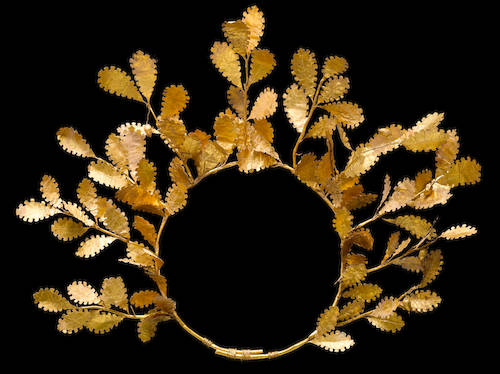
The London auction house Bonham's is going to auction (Sale 17822, 28.04.2010) a gold wreath similar to that found in the excavation of Vergina. Auction on the 28.04.2010 and 29.04.2010.

This stunning artefact, estimated £100,000 - 120,000, may once have graced the head of a ruler or dignitary over 2,000 years ago. “The fact that this delicate collection of fine gold leaves and acorns formed into a wreath has survived the centuries is almost miraculous,” says Madeleine Perridge, Antiquities Specialist at Bonhams. Previously in a private collection since the 1930s, “it is a beautiful example of a type that is rare to the market.”

The item then has a supposed provenance of an old collection of the 1930s, which if true will impede any efforts to reclaim the item.

The new Greek Directorate of Illegal Commerce of Antiquities of the Ministry of Culture is working on the case and has asked Bonhams for detailed photographs and the exact provenance of certain pieces.

Apparently three unnamed Greek archaeologists ("specialised in ancient jewellery from Northern Greece"), judging from the photographs of the crown were wary of its authentisity, but also of its "Macedonian" provenance. The type and make of the oak leaves caused doubts, despite "the size and shape being identical to the well know royal crowns". Their only conclusion was that only a macroscopic examination could lead to certain conclusions. (N. Kontrarou-Rassia, Eleutherotypia, 09.04.2010).


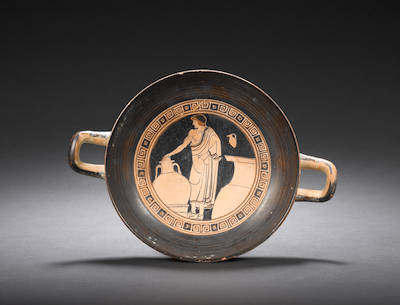
The same auction will see the sale of a fine collection of attic vases, including an Attic red-figure stemless kylix by Douris, circa 480 B.C. showing a draped youth with defined musculature, standing in an Athenian wine-shop amongst large amphorae, (estimate £30,000-40,000). Exhibited in the Fogg Art Museum at Harvard from 1937, this drinking cup is a fascinating image of Athenian life in the Classical period. Provenance given in catalogue: "Ex Professor Jakob Rosenberg Collection, Cambridge Massachusetts, 1937. Property of a private English collector. Acquired from Sotheby's New York, May 30th 1986, lot 19." This one at least has an early provenance (1937), something that is definetly not the case for many of the items in the sale...


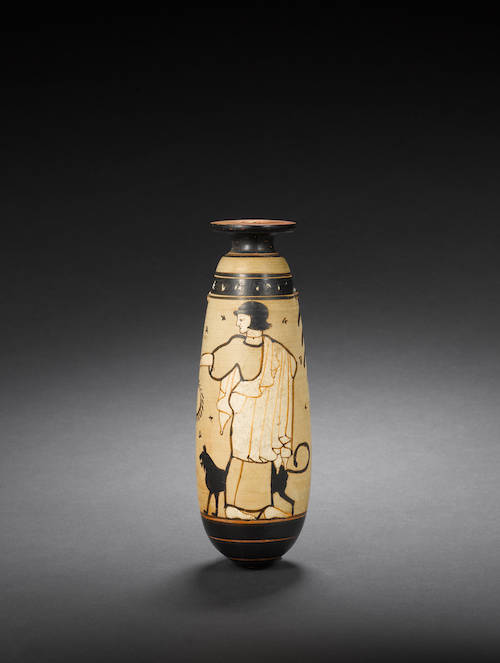
An unusual intact Attic white-ground alabastron of the group of the Negro Alabastra, (circa 490-480 B.C.) showing a female figure walking to the right and turning to look back, draped in a chiton with himation and wearing a necklace and bracelet, holding a wreath in her right arm. A black lion walks behind her, with a palm tree on the far left, the word 'KALOS' (beauty) inscribed three times around the figure. Estimate £30,000-50,000. The name Melanphis Kale can be translated as 'Black Flower'. Such alabastra were given as love gifts and the frequent use of 'Kalos' supports this.

Details concerning the provenance given in the catalogue: "Provenance:
Property of a private English collector. Acquired at Christie's London, 28 April 1993, A Private Collection of Important Greek Vases', lot 29 where the collection is described as 'well known to J.D. Beazley'.

Exhibited:
The Ashmolean Museum, Oxford from 2001 to 2009. This lot is accompanied by its Ashmolean display card.
" Yup, yet another piece from an unnamed Priavate English Collection - well known to Beazley! Earliest date mentioned: 1993!


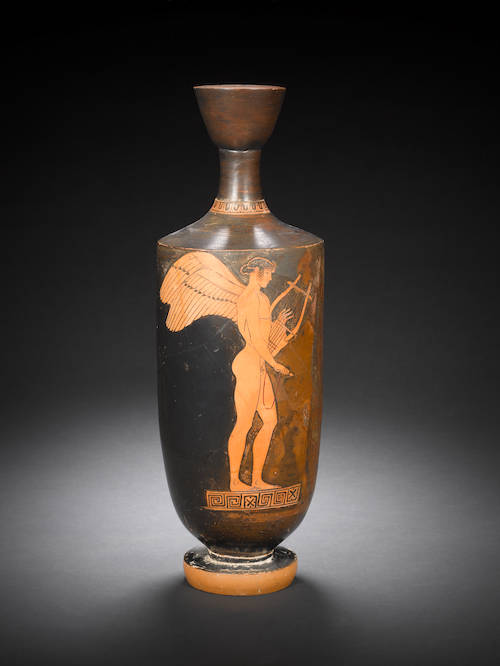
An Attic red-figure lekythos finely painted by the Providence Painter, (circa 5th Century B.C.) depicts the god Eros as a young man, standing nude, in profile to his left, his wings behind him, holding a kithara in his left hand, a plectrum on a red ribbon in his right.
Estimate £25,000-35,000
Details given in the Bonham's catalogue: "Property of a private English collector. Previously acquired at Sotheby's London, 13-14 December 1982, lot 84. Exhibited: The Ashmolean Museum, Oxford from 2001 to 2009. Published: Archaiologikon Deltion, vol. 36 (1981), p.1, pl.56B. For a similar work by the Providence Painter, cf. T.H. Carpenter, with T. Mannack, & M. Mendonca, Beazley Addenda, 2nd edition (Oxford, 1989)p. 274." Yet another piece from a private Enlish Collector! Earliest date it is mentioned? 1981.


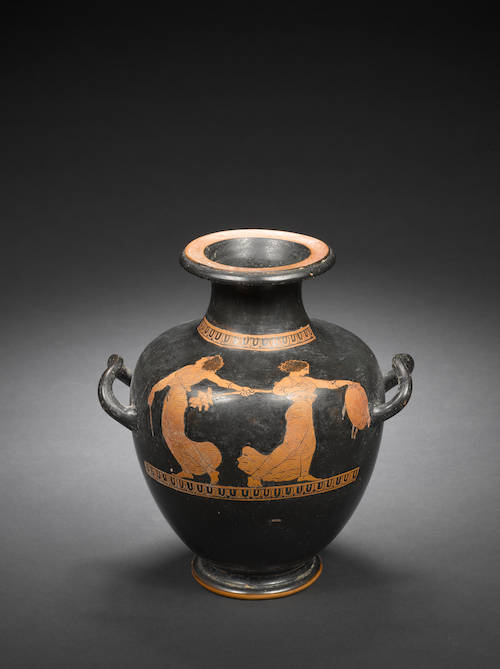
An Attic red-figure hydria in the manner of the Medeia Painter, (Circa 420 B.C.) depicts two Maenads draped in clinging diaphanous chitons, dancing away from each other while holding a number of ritual objects. It is estimated to sell for £25,000-35,000. The provenance given in the Bonham's catalogue: "Property of a private English collector. Acquired at Christie's London, 28 April 1993, A Private Collection of Important Greek Vases', lot 29 where the collection is described as 'well known to J.D. Beazley'. " Meaning its history starts in 1993!!


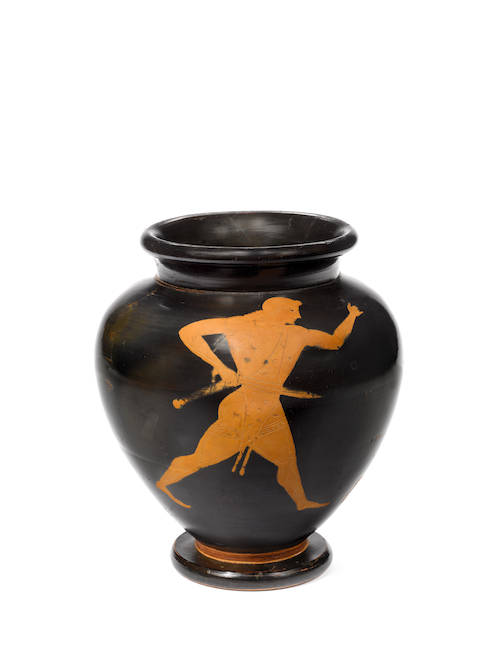
An unusual Attic stamnos painted in the rare Six technique, from the workshop of the Antimenes Painter, circa 510 B.C. showing Theseus and the Minotaur with Ariadne. Estimated to sell for
£150,000-250,000, it was previously in the Ferrucio Bolla Collection in the 1950s and the Stavros S. Niarchos Collection, and it has been exhibited at the J. Paul Getty Museum, Malibu, in 1980.


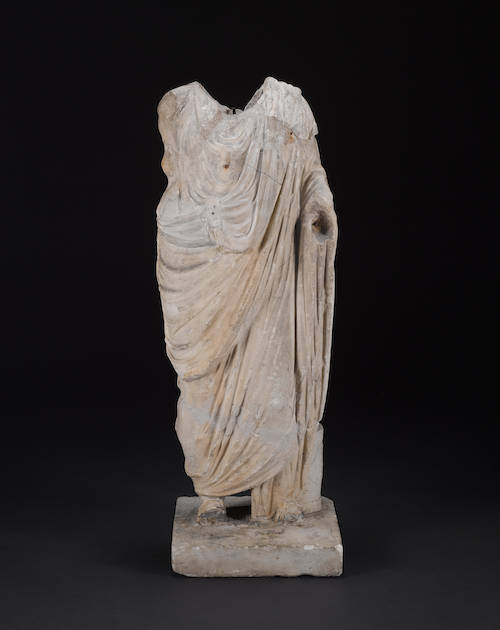
Lot 138. A Roman marble statue of a Togatus
Circa 1st-2nd Century A.D.

Provenance given in Bonham's Catalogue:

"Ex UK collection until 2008. Acquired on the Paris art market in 2009." That's interesting...Yet another unnamed Private UK collection! Earliest provenance date: 2008!!


Lot No: 143
A Roman marble male torso
Circa 2nd Century A.D.

Provenance given: "Ex European private collection, acquired by the present owner prior to 2000." Wow! How vague is that? A private "European" collection, that acquired the piece ten years ago? That does sound cozy!


Lot No: 137W
A Roman marble figure of a youth
Circa 1st-2nd Century A.D.
Standing naked, the weight on his right leg, his left leg relaxed, supported by the column and strut on his left, standing on an integral base, 27in (68.6cm) high

Estimate: £20,000 - 30,000

Footnote:
Provenance:
Acquired at Sotheby's London, 8th-9th December 1986, lot 287.

Literature:
Probably depicting a young satyr or Apollo, cf. M. Bieber, The Sculpture of the Hellenistic Age, (New York, 1955), figs. 18 & 86.


...and here is a polaroid of the same statue. It is one of the polaroids illustrating what past through the hands of Giacomo Medici that were confiscated during the raid on the warehouses in the Geneva Freeport. See: Looting Matters, 21.04.2010.


In a word, browse through the catalogue and you will find that every other piece has a provenance that does not stand up to scrutiny. Even if we take the given dates linked with the provenance at face value (although of the older ones many are vague and usually linked to "[unnamed] private collections of the 1930s"), most are way after the generally accepted "truce" date of 1970 (the date of the UNESCO Convention), meaning that there are gaping gaps concerning the items history, including the date and place of discovery and the circumstances of its export from the country of origin.

Of course, as is common practice in the Antiquities Commerce, Bonham's, by giving no place of origin hopes to confound any challenges to its right to sell the items: if the challenger cannot prove the country of origin, there is no way the item can be reclaimed by a particular country.

And of course the end-loser is scientific knowledge, as the objects ripped from their archaeological context offer very little to research, compared to what would have been gained if we possessed their full data.

Sources:

Tuesday, 16 March 2010

The Merchants opinion on the Commerce of Antiquities

Collectors and Archaeologists Find Common Ground on Cultural Property Management at Newcastle, U.K. Conference

GAINESVILLE, Mo., March 16 /PRNewswire/ -- On 13th March, Wayne G. Sayles, the executive director of the Ancient Coin Collectors Guild (ACCG) gave a PowerPoint presentation at Newcastle outlining the 61-page paper, "Coin Collectors and Cultural Property Nationalism." The paper, covering cultural property history, law and philosophy, was a collaborative ACCG effort prepared in response to the event:

http://www.accg.us/issues/news/NewcastlePaper.pdf

The two-day conference, "Portable Antiquities: Archaeology, Collecting, Metal Detecting" was organized by the Council for British Archaeology (CBA) and the International Centre for Cultural and Heritage Studies (ICCHS). It was held at the University of Newcastle and at the Great North Museum.

In their announcement for the event, the CBA said:

"Papers will address recent research, new initiatives and ultimately discuss what the future holds for portable antiquity management and protection in the UK and further afield. Speakers include individuals from archaeological, collecting, metal detecting and law backgrounds." See:

http://www.britarch.ac.uk/cba/events/portants2010

The ACCG endorses much of the British system for handling finds of portable antiquities, especially the Treasure Act and the Portable Antiquities Scheme for England and Wales (Scotland and the Isle of Man having their own laws on the subject). The Guild maintains that a spirit of friendly cooperation between professional and amateur archaeologists, numismatists, metal detectorists, independent scholars and the public in general is the best way forward and it condemns the increasingly draconian cultural property laws of some countries as being both unworkable and backward-thinking.

The ACCG supports the U.S.-based Ancient Coins for Education (ACE) projects:

http://ancientcoinsforeducation.org/ and has also set up a fund for small museums in England and Wales who wish to purchase local ancient coin finds to be able to do so under the terms of the Treasure Act when they are not eligible for other grants:

http://www.accg.us/accg-museum-fund

The Newcastle conference might well be characterized as the construction of a fresh bridge between archaeologists, museums, metal detectorists and collectors. Two days of hearing and discussing weighty cultural property issues, in a friendly and meaningful way, left the participants with broader perspectives and a genuine interest in moving forward.

A link to a fuller summary of the conference will soon appear at:

http://www.accg.us/news

Sources: Ancient Coin Collectors Guild via PRNewswire
...............................................................................................................................
Predictably the ACCGs paper is a poor collection of sofist trics that try to stick the lable of "Nationalist" (sic!!) on anyone who does not agree to allow them a free hand in exporting antiquities...I may return to this at a later date when I have a moment, but I am sure that anyone reading the text can see for himself the leaps of logic required to follow its reasoning...