The Macedonian type tombs of Amphipolis, although more than fifty years have passed since their discovery, remain unknown to the wider public.
By Aris Mendizis
Source: Χρονόμετρο, 26.10.2014 (Translated by A.M.)
Accross from the eastern side of the ancient city of Amphipolis, on the first slopes of the sacred mountain of antiquity, mount Pangeum, another six Macedonian tombs of excellent quality were discovered and excavated by Demetrios Lazaridis, giving much and useful information about this great urban centre of antiquity.
These Macedonian type tombs are six in number and are situated just south of the Hellenistic cemetery, where the same archaeologist excavated over 400 tombs, and North-West of the ancient walls. In his book on Aphipolis, the excavator Demetios Lazaridis, gives much information about six of these funerary constructions, showing that they were special at the time of their creation.
 |
| The arched corridor of the Tomb no 1 |
Macedonian Tomb 1
Concerning the "Macedonian Tomb 1", as it was named , it was discovered in 1960 and is covered by an artificial mound. It is comprised of an arched corridor 5.30 m in length and 1.60 m wide, an antechamber and a main chamber Unfortunately in this tomb the ceiling has caved in over the antechamber and the main chamber. It is worth noting that the total length of this tomb is 11.30 m and, up to the discovery of the funerary construction in the "Kastas" hill, it was the largest known tomb of Amphipolis. On the right hand side of the antechamber there is a funerary litter built of limestone blocks. In the main chamber a further two such beds were found at a right angle to each other. These two litters were covered in lime stucco decorated in bright colours. On the legs of the bed and on its upper part, according to D. Lazaridis, Dionysian figures are depicted, seated on rocks or reclining on the ground holding
thyrsoi, small lions, altars etc. Rosettes and various other geometric, for the most part, shapes cover the legs of the beds.
 |
The funerary biers of Macedonian Tomb 1, as they were exhibited in the Kavala Museum.
|
The offerings that accompanied the dead woman in this tomb were rich. They included two large gold rings with coloured stones that bear engraved figures, a gold wreath of olive-leaves, flowers and leaves made of gold-leaf, a pair of golden ear-rings that end in lionheads, a golden obol [
sic] bearing the head of Hercules in a lion skin, a silver mirror, various pots and a
pyxis. The paintings on the beds were recorded and then transported to the Museum of Kavala, where they were exhibited until a few years ago, in a representation of a funerary chamber in the Amphipolis hall. This important tomb, according to its excavator, is dated to the 3rd century B.C.
Macedonian Tomb 2
Close to the previous tomb, to the south-east another Macedonian Tomb was discovered in 1961, below a tumulus. This tomb is built with lime blocks and comprises of a corridor of 6.28 m length and 1.36 m. width and of a funerary chamber measuring 3.06 m X 3.08 m covered with an arched ceiling. Part of the corridor is also covered with limestone slabs.
In the funerary chamber one can enter via an entrance 1.25 m wide. On the western and the northern side there are funerary litters forming a right angle, made of limestone blocks. Unfortunately the were partially destroyed by grave-diggers who violated the tomb. From the few ceramic finds that were discovered on the floor of the chamber, the tomb is probably to be dated to the second half of the 3rd century BC.
 |
| The entrance and corridor of Macedonian Tomb 2 |
 |
| The covered corridor and the entrance to the funerary chamber of Macedonian Tomb 2. |
Macedonian Tomb 3
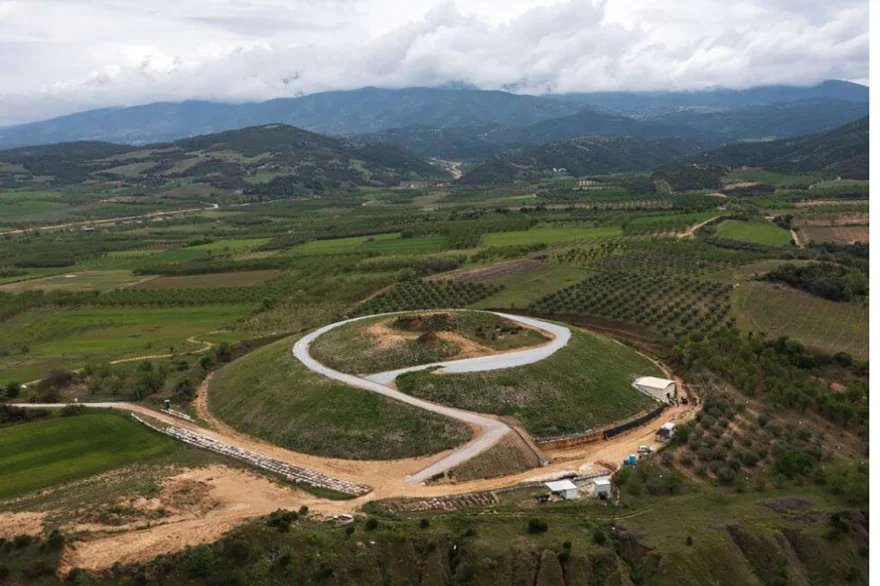
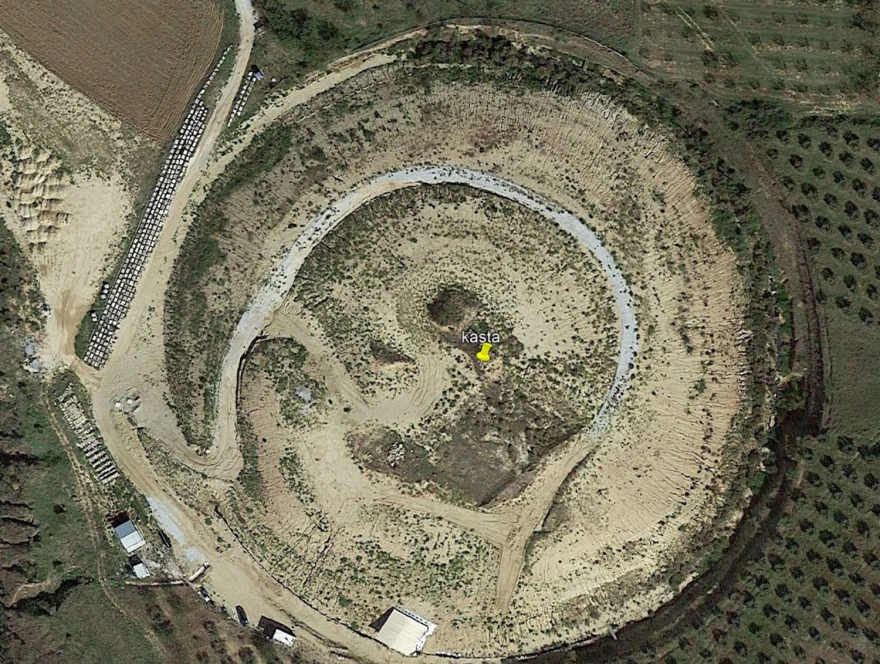
Yet another especially important tomb of the Macedonian type, which is situated on the "Kastas" Hill, which has lately come into the limelight. Despite all the interest however, few know that on this hill a second, albeit smaller, Macedonian tomb is to be found.
This tomb was discovered in 1960, during extensive research carried out by D. Lazaridis on the hill, but unfortunately it had been opened and partially destroyed. This tomb comprises of an antechaber and a funerary chhaber and is 9m long and 3.07 m wide. It is dated to the 3rd century BC.
It was carved into the lining rock and its walls are covered with limestone blocks, of which only the lower row is preserved. The lower parts of the walls are covered in plaster mimicking marble slabs.
It is interesting that the floor of the antechamber was covered with a mosaic decorated with multicolour lozenges, while the floor of the main chamber was separeted into three zones of deep red and yellow colour. On the northern part the floor had been broken to create a second tomb apart from the first tomb which was situated on the far wall of the main chamber. The walls of the two tombs were covered in brightly coloured plaster, such as red, yellow, black, white etc, while in one of them there was a decoration of flowers, plants, birds, vases etc. The mosaic and the wall-paintings were removed to be preserved.
 |
The Mosaic Floor of Macedonian Tomb 3
|
Macedonian Tomb 4
It is worth noting the near this tomb yet another Macedonian type tomb was discovered, in which many
pyxis were discovered, as well as two ceramic statuettes, various bronze and glass objects and a gold ring.
Macedonian Tomb 5, aka "Tomb of the Doctor"
On the eastern outer side of the walls of Amphipolis, near the little church of Agios Nikolaos, another cemetery of the late Hellenistic and Roman period was located in 1959. In it another tomb of the Macedonian Type was unearthed, dating to the Roman period.
It comprises of a corridor 3 m long and a funerary chamber measuring 2.55 m X 3.55 m, in the three walls of which five alcoves are to be found. On the lintel of the tomb an inscription was discovered mentionaing that it was the tomb of the doctor Sextus Iulius Haritonos (
Σέξτου Ιουλίου Χαρίτωνος) and is dated to 74 AD.
Macedonian Tomb 6
In the cemetery to the North-West of ancient Amphipolis D. Lazaridis discovered yet another Macedonian Type tomb in 1960, which comprises of a corridor 5.30 m in length and 1.58 m wide, and a funerary chamber measuring 2.90 m X 3.08 m. Its entrance was sealed with a rough wall of limestone blocks.
In the floor of the corridor, at a distance of 2.15 m from the entrance, a circular hole of unknown use was discovered, having a diameter of 55 cm and a depth of 40 cm. In the tomb six burials were discovered. The four where on the floor and two in alcoves that had been made for this purpose. Among the finds were vases; two strigils, a pair of gold ear-rings, a gold ring, a glass multicoloured vase, a bronze mirror etc. The tomb is dated by the excavator to the middle Hellenistic period.
 |
| The sealed entrance of the Macedonian Tomb 6, as found during excavation |
Sources of teh Photographs:
Photographs 1,2,3,4 : Δ. Λαζαρίδη, Αμφίπολις, Εκδόσεις Ταμείου Αρχαιολογικών Πόρων και Απαλλοτριώσεων, Υπουργείο Πολιτισμού, Αθήνα 1993 [D. Lazaridis, Amphipolis, Ministry of Culture, Athens 1993.]
Photographs 5,6 : Δ. Λαζαρίδη, «Ανασκαφαί και έρευναι Αμφιπόλεως», Πρακτικά της εν Αθήναις Αρχαιολογικής Εταιρίας, Απόσπασμα του έτους 1960, Αθήνα 1965 [D. Lazaridis, "Excavations and Researches of Amphipolis", Praktika of the Archaeological School in Athens, 1960, Athens 1965.]