Showing posts with label Alexander III. Show all posts

Tuesday, 20 April 2010

ALEXANDER THE GREAT: FROM MACEDONIA TO THE EDGE OF THE WORLD


ALEXANDER THE GREAT: FROM MACEDONIA TO THE EDGE OF THE WORLD
(Archaeological Museum of Ioannina)

The new exhibition of the Alpha Bank Numismatic Collection
entitled “ALEXANDER THE GREAT: FROM MACEDONIA
TO THE EDGE OF THE WORLD” is presented at the
Archaeological Museum of Ioannina as of Friday 7 May 2010.

The exhibition organised by Alpha Bank, in collaboration with
the Archaeological Museum of Ioannina, for the first time in
Ioannina, refers to the history of Alexander the Great through
his coinage and its effect on the ancient world even after his
death.

The exhibition is accompanied by a fully illustrated catalogue
- album in Greek and English.

Exhibition duration: 7 May – 31 October 2010

Thursday, 1 April 2010

(T) Vergina/ Aigai: A Walk in the Traces of Alexander

A Virtual Museum and archaeological park at Aigai.

by Giota Sykka

It is time to leave behind outdated ideas that imagine that a museum is a building with tens of showcases and thousands of objects, presented to visitors, limiting them a passive tour. The example of something different comes from Aigai with an ensemble of interventions in the legendary necropolis, that offer the opportunity for a charming promenade between separated poles and with it the delight of discovery.

An open museum that unifies, protects and shows up all the monuments of this enormous archaeological site, of which but a small part has been excavated and only the royal tombs of the Philip II group are open to visit.

However the 200,000 visitors that arrive each year - despite the fact that neither profound interventions have been carried out nor has the site been arranged to take advantage of it - show that they "thirst" to learn any information concerning the ancient Macedonian metropolis and its protagonists.

These problems shall be taken care of by the Multicentered Museum of Aigai in which the public, through a grand open promenade shall walk amongst the monuments and the natural environment, will halt under roofing and will follow courses, will travel in the environment and the history and will be able to have a direct appreciation of the site where Philip II and his son Alexander lived, walked and were active.

The enthusiastic and active archaeologist Aggeliki Kottaridi, responsible for the study of all these interventions, a veritable master plan which defines the principles of all that will be carried out in the archaeological site, has other plans as well - as long as money can be found!

For example the Virtual Museum of Alexander the Great which will take us to the country where the Great general was born and raised, informing us of the roots of his dynasty and his great adventure, that continues to fascinate.

Greece, instead of participating in others programmes, by lending antiquities to exhibitions and allowing filming in its sites and museums, can advance in a responsible and defining way toward the veritable administration of its past and heritage: thus goes the argument of the archaeologist.

The Virtual Museum shall function on two levels: on the Internet through a portal, and in its natural environment, at the Museum of Aigai, through a hall of realistic imagery projections; As dr Kottaridi underlines "it was in Aigai that Philip II was murdered and Alexander the Great was proclaimed King, and it was from here that in the spring of 334 B.C. commenced - according to Arrian- with festivities and sacrifices to the Gods, the great expedition that changed the history of the world".

The work shall be a coordinated effort to gather all known sources, interpretations and approaches, aiming at the production and composition of cultural content concerning the life and work of Alexander the Great in the World's Culture. To avoid historical distortion and inexactitudes, but also to promote the idea of free and equal coexistence of different cultures: "In parallel it shall be a new beginning for intercultural contacts and exchanges with states of North Africa and Asia".

The plan was approved with congratulations by the Central Archaeological Council, which was also informed of the present image and problems of the archaeological site of Aigai.

Apart from the Royal group A and the Palace on which conservation work is being carried out, all the rest of the monuments and remains are crudely protected by roofing and metal plating. The interventions are minimal or non-existent. Of 450 tumuli few have been excavated, while the lack of fencing results in the accumulation of rubbish and waste. The access to the Palace and the burial group of the queens from the West is inadequate, as it does not correspond to the structure of the Ancient City, while the hellenistic grave group Heuzey-Mpellas and the Palaio-christian and Late Byzantine monuments are not connected to the rest of the site.

The stored treasures of the Royal Tombs, more than 30,000, remain unknown to the public, which cannot even buy an official Museum guide, as it has not yet been published!

This real lack of interventions on the site is covered by the plan, which adds pedestrian bridges, fencing, the planting of trees and plans, excavation of the tumuli, while allowing the public to watch on... So that a walk in the Aigai area shall really be charming.

Source: Kathimerini, 01.04.2010
Translation: ArchaeologyMatters

See also:

Saturday, 27 March 2010

Alexander the Great Exhibition


The Exhibition "Alexander the Great: His Life and Influence" opened in Leoben Museum, Austria in March 2010, after completing its run in Germany in Mannheim (October 2009 - February 2010.

The exhibition contains over 400 objects from 35 of the biggest Museums of Europe and Asia.


Image from Ethnos


Tuesday, 16 March 2010

Two men arrested attempting to sell antiquities. Lysippos (?) bronze statue of Alexander among the loot.


Greek police arrest 2 with valuable antiquities

THESSALONIKI, Greece — Greek police arrested two men trying to sell several artifacts, including a bronze sculpture of emperor Alexander the Great from the 4th century B.C., for which the asking price was euro7 million ($9.5 million), authorities said Sunday.

Police identified the suspects as a 48-year-old Thessaloniki businessman and a 51-year-old farmer, but did not provide their names.


This image made available on Sunday, Feb. 28, 2010 by Greek police shows in the northern Greek port city of Thessaloniki a bronze statue of emperor Alexander the Great flanked by two bronze heads from the Roman period. Police arrested two individuals trying to sell these and other antiquities on Saturday. The asking price for the Alexander statue alone was 7 million euros. Experts say the statue is likely from the workshop of Lysippos, a 4th century BC Greek sculptor who was Alexander's contemporary and personal sculptor. (AP Photo/Greek Police)


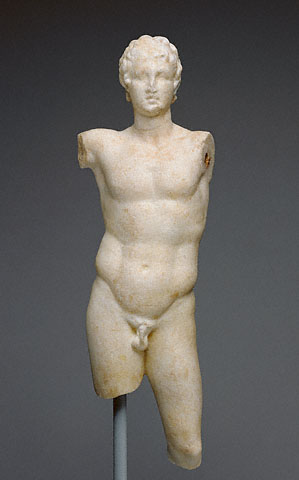
The marble copy from the Getty Museum.


The men were arrested Saturday morning near the town of Kavala, east of Thessaloniki, police said. Police searched their car and found a treasure trove that included a 65-centimeter (2-foot) statue of Alexander, two bronze heads of a boy and a young man and other artifacts, including two rare Qurans.

"According to our information, the (suspects) have been trying to sell the sculptures for about a year," senior Thessaloniki police official Dimitris Tsaknakis told The Associated Press. "They have been asking euro 7 million for the Alexander sculpture and between euro 4-6 million ($5.43 million-$8.14 million) for the boy's bronze head."


The Louvre copy.

Experts say the Alexander statue appeared to come from the workshop of Lysippos, Alexander's personal sculptor. Chemical tests are being conducted at the Thessaloniki Archaeological Museum to see whether the sculpture is an original or a contemporary copy, since Lysippos' workshop, which employed several artists, also produced replicas of original works.

The young boy's bronze head, apparently part of a larger sculpture, is dated from the Roman era, in the 1st century B.C.

Police officials say it is likely the two smuggled the antiquities and the Qurans from Turkey, but at this point they are not certain about their place of origin.


Comparison of three statues: Getty Museum. Thessalonike. The The Louvre. The (newly-found) Thessolonike statue is the mirror image of the other two, but otherwise all three have a source-relationship (i.e. they all three copy the same source/model or the two are copies of the other)... In any case it is certain that Lysippos and his workshop themselves produced a variety of statues of the same type varying in details and size.

Concerning the Lysippos statue the following hypothesis are possible:

a. The head and the body were created at the same time. This means that we not only have the first known statue created by Lysippos and his workshop but the first actual representation of Alexander III, dating from his lifetime!

If the head is prooven to have been added at a later date:

b. it will be interesting to discover whether the addition was made in antiquity (to replace a damaged head), or
c. The addition was made in modern times. If this is the case - and the hypothesis is reinforced both by the crudeness of the head and the presence of the fake head of an adolescent amongst the objects confiscated - then we can but once again only wonder at the high level of organisation of the antiquities-trafficing circuits: Not only did they work with someone able to identify Lysippos' Alexander, but they had the knowledge
(although fortunately not the know-how to pull of the scam!) to create a head with the main characteristics of Alexander, including the famous anastole of his hair. All this shows, once again, how sophisticated the people who deal in the illegal trade of antiquities are - and by all accounts always have been (we shall go into this at a later date: suffice it to say that ALL famous collections - including all the big museums - have been proven to have included fakes as originals at some point at least of their history!). Of course if the, by all accounts, narcissistic king had seen their attempt to render his head, I would hate to imagine what he would have done to them!
d. Of course there is the possibility that both the body and the head are fakes, which brings us back to the remarks we have already made concerning the antiquity commerce circuits.

---------------------------------------------- 
UPDATE 11/2023: 

In the acts of the colloqium «Αρχαιοκαπηλία Ιστορία, πολιτιστική πολιτική και νομική διαχείριση», the object is simpli listed (p. 53, no 7) by Demetrios Papaoikonomou as being among the objects confiscated by the authorities. There is no information about its current whereabouts or any more information concerning its identification.